Home/ Startup Finance/ Article
Advance tax when your income is lumpy

A salaried person rarely thinks about advance tax, because the employer deducts it monthly and the problem is solved. Start consulting, and the problem becomes yours — on a schedule designed for businesses that can forecast, applied to income that arrives when a client finally approves an invoice.
When it applies
Advance tax is due if your tax liability for the year, after TDS, exceeds ₹10,000.
That threshold is lower than it sounds. Clients deduct TDS at 10% under section 194J on professional fees. If you are in the 30% bracket, 10% does not come close to covering the liability, and the gap is yours to pay in instalments.
Resident senior citizens with no business income are exempt entirely. Nobody else is.
The two schedules
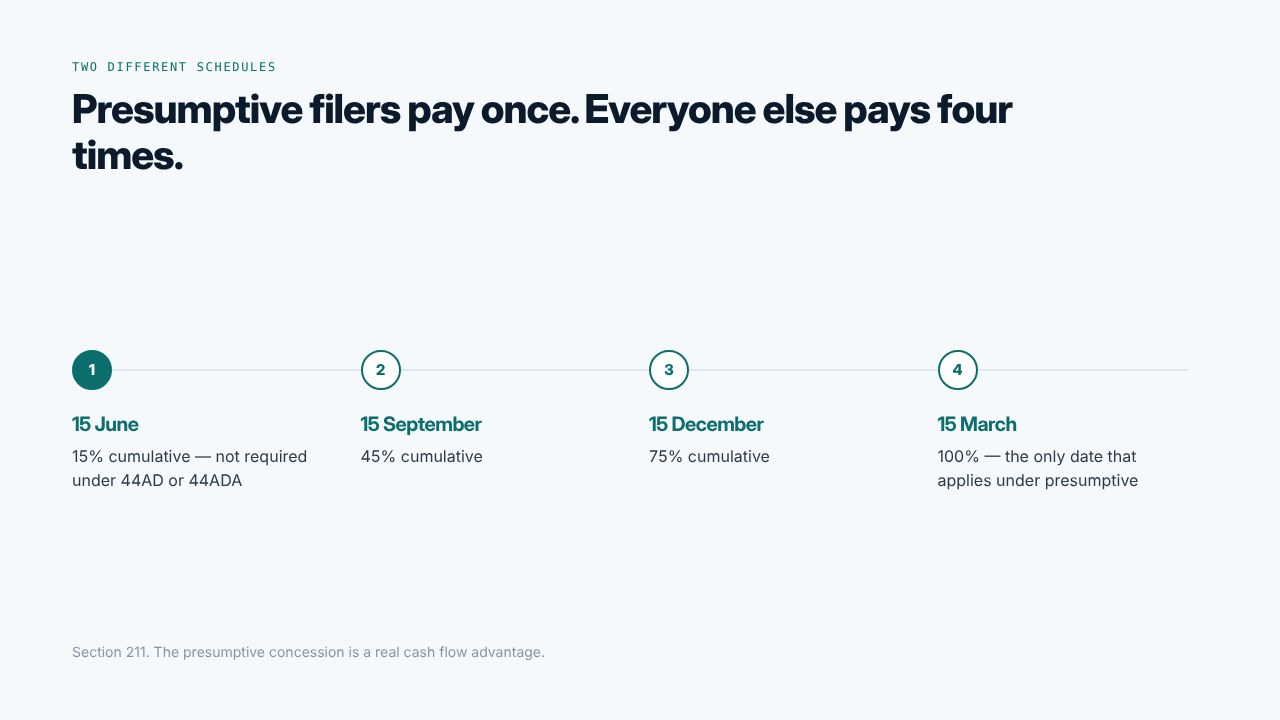
The general schedule has four dates: 15% by 15 June, 45% by 15 September, 75% by 15 December and 100% by 15 March. Each figure is cumulative.
If you file under the presumptive scheme — section 44ADA for professionals, 44AD for businesses — there is a single date: 100% by 15 March. That is a genuine cash flow advantage and one of the better reasons to use the scheme if you qualify.
Forecasting income you cannot forecast
The honest answer is that you estimate, and you revise.
A workable method: in June, base the estimate on last year's income unless you already know it will be very different. Pay 15% of that. In September and December, recompute using actual receipts to date plus a conservative projection for the rest of the year, and pay the cumulative figure less what you have already paid. In March, you know almost everything, so square it up.
Over-estimating is not expensive — the excess comes back as a refund with interest under section 244A. Under-estimating costs 1% a month. The asymmetry argues for erring high.
The instalment calculator converts a liability estimate into the four payments, net of TDS already deducted.
The three interest sections
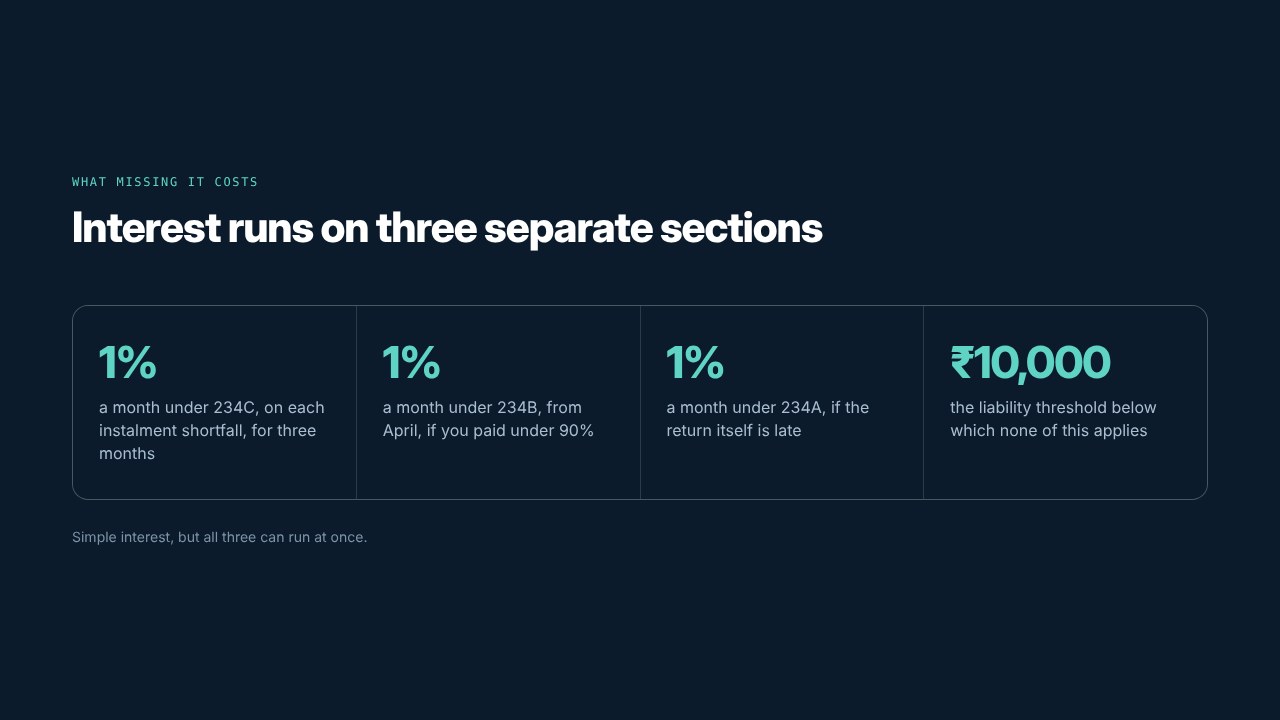
They are separate, they are cumulative, and all three can apply to the same year.
234C charges 1% a month for three months on each instalment shortfall. It is capped at three months per instalment, so a June shortfall corrected in September costs 3%, not six months of interest.
234B charges 1% a month from 1 April until payment, if your total advance tax paid is under 90% of the final liability. This one runs until you pay, so a return filed in July means four months of interest.
234A charges 1% a month if the return itself is filed late, on the unpaid tax.
The relief for income you could not predict
The law accepts that some income cannot be forecast. Capital gains, lottery winnings and dividend income get specific protection: tax on a gain arising after an instalment date can be paid in the next instalment — or by 31 March for a gain in the final quarter — without attracting 234C on the earlier shortfall.
This does not extend to professional fees. A large invoice settled in February was, in the department's view, foreseeable. The relief is narrower than freelancers tend to assume.
Practical habits
Open a second account. Move 30% of every client payment into it the day it lands. The instalment is then a transfer rather than a scramble, and the money was never in your spending account to begin with.
Reconcile 26AS quarterly, not annually. Clients deduct TDS and occasionally fail to deposit it, or deposit it against the wrong PAN. Found in July, it is a conversation. Found in March, it is a shortfall.
Decide on presumptive early. Under 44ADA you declare 50% of receipts as income and keep no books. If your actual expenses are well under half your receipts — common for a consultant with a laptop and no staff — it is both simpler and cheaper. Compare the two before the year starts, because opting out of 44AD later locks you out for five years.
Use the right challan. Advance tax is minor head 100. Self-assessment tax is 300. Paying under the wrong head means the credit does not appear where it should, and correcting it is a request to the assessing officer rather than a click.
Read next
 Startup Finance
What a startup should keep in its books from day one
Clean books are cheaper to maintain than to reconstruct.