Home/ Checklists/ Article
Buying a flat: the paperwork, in the order you need it

A flat purchase goes wrong in one of two ways. Either the title is not what you were told, or the money runs out a week before registration because nobody added up the costs that sit outside the price. Both are avoidable with a list.
Before you pay a token
The token advance is the moment your leverage disappears, so everything that matters should be checked before it changes hands.
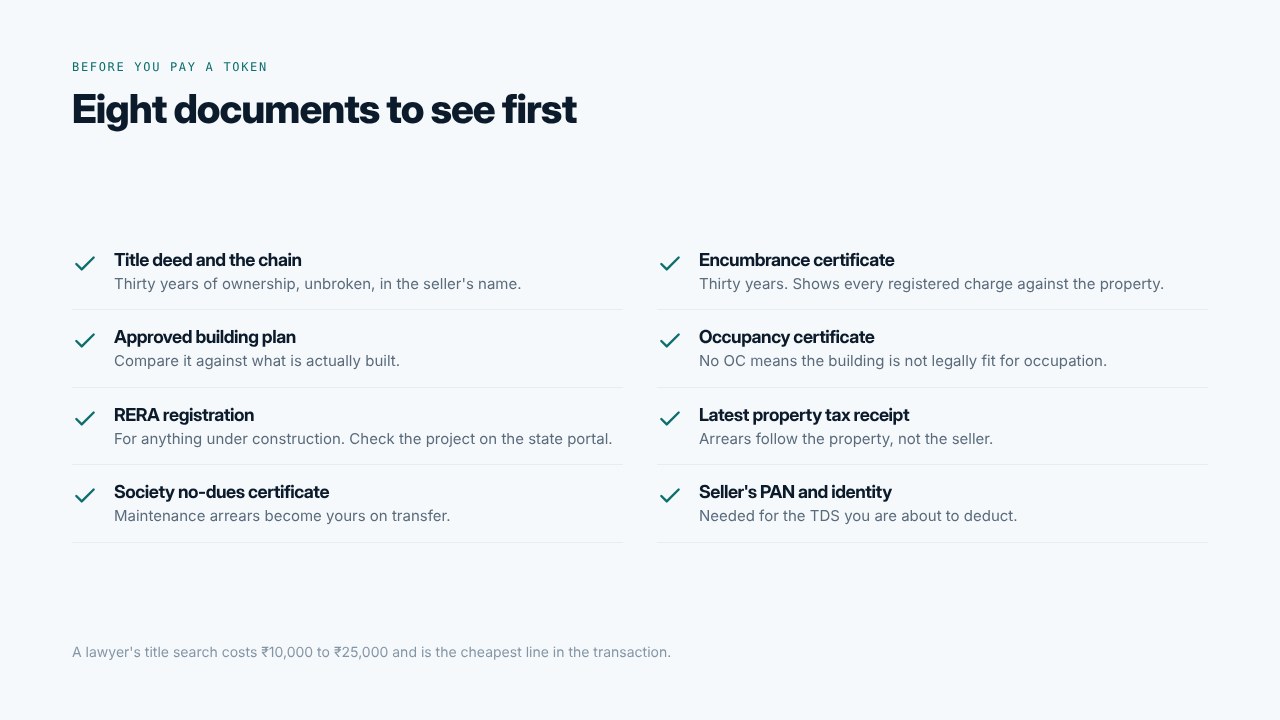
The title deed and the chain of title. Not just the current deed — the sequence of transfers going back thirty years. You are looking for an unbroken chain ending with the person selling to you. Gaps, unregistered transfers and inherited property without a succession certificate are where disputes come from.
Encumbrance certificate for thirty years. Obtained from the sub-registrar, it lists every registered transaction against the property — mortgages, liens, charges. A property with a subsisting mortgage can still be sold, but the loan must be cleared and the charge released, and you need to see that happen.
The approved building plan, compared with what exists. Unapproved additions are common — a covered balcony, an extra floor. They are the buyer's problem after registration, and they can block a future loan or sale.
Occupancy certificate. Issued by the municipal authority once construction is complete and compliant. Without it the building is not legally fit for occupation, and banks are increasingly refusing loans against flats that lack one. Possession is not the same thing as an OC.
RERA registration, for anything under construction. Look the project up on the state RERA portal yourself rather than taking the number from a brochure. The portal shows the promised completion date, the approvals on file and any complaints.
The two that get skipped
Property tax receipts. Arrears attach to the property, not to the person who incurred them. Ask for the latest receipt and check the municipal portal for dues. Clearing someone else's five years of unpaid tax after registration is not a conversation you will win.
Society no-dues certificate. Maintenance arrears, sinking fund contributions and any special levy transfer with the flat. Societies are entitled to withhold a no-objection certificate until they are paid, and without an NOC the transfer does not complete.
The money nobody budgets for
On a ₹80 lakh flat the price is ₹80 lakh. The transaction is not.
Stamp duty runs 5% to 7% depending on the state, with a concession for female buyers in several of them — worth registering in a wife's or mother's name where that applies. Registration is typically 1%. Loan processing, legal opinion and valuation add ₹25,000 to ₹50,000. Brokerage, where there is a broker, is usually 1% to 2%.
Together that is 8% to 10% of the price, in cash, none of which the bank will lend against. On ₹80 lakh it is ₹6.4 lakh to ₹8 lakh on top of the down payment.

The TDS you are responsible for
At ₹50 lakh and above, section 194-IA makes you — the buyer — responsible for deducting 1% of the consideration and depositing it with Form 26QB within 30 days of the end of the month of payment.
Not 1% of the excess over ₹50 lakh. One percent of the whole amount. And the threshold looks at the property, so joint buyers cannot split their way under it; each pair of buyer and seller files its own 26QB.
If the seller is a non-resident, this does not apply at all — section 195 does instead, the rate is far higher, and you need a TAN. That is a case for professional help before any money moves. Work out the deduction and tell the seller the net figure early, because they will otherwise expect the full amount at registration.
Registration day
Both parties present with identity proof, two witnesses, the sale deed on the correct stamp paper, the TDS challan, and the payment instruments. The sub-registrar takes biometrics and photographs.
Afterwards, three things people forget: collect the registered deed once scanning is complete, apply for mutation so municipal records show you as owner, and transfer the electricity and water connections. Mutation in particular is skipped constantly and becomes a problem years later when you sell.
If it is under construction
Pay according to the RERA-mandated construction-linked schedule, not the builder's preferred front-loading. Keep every receipt. Check the carpet area in the agreement — RERA requires carpet area, while brochures still quote super built-up, and the difference is routinely 25% to 30%.
And read the clause on delay compensation before signing. It is the one provision you will care about, and it is usually the one written most favourably to the builder.