Home/ Financial Reporting/ Article
A thirteen-week cash flow forecast, and why profit is not the number to watch
A business can be profitable on paper every month of the year and still be unable to pay salaries in August. Profit is recorded when you invoice. Cash arrives when the customer pays. The gap between those two events is where businesses fail, and it widens as you grow.
Why growth makes it worse
This is the part that catches founders by surprise. Growing faster consumes more cash, not less.
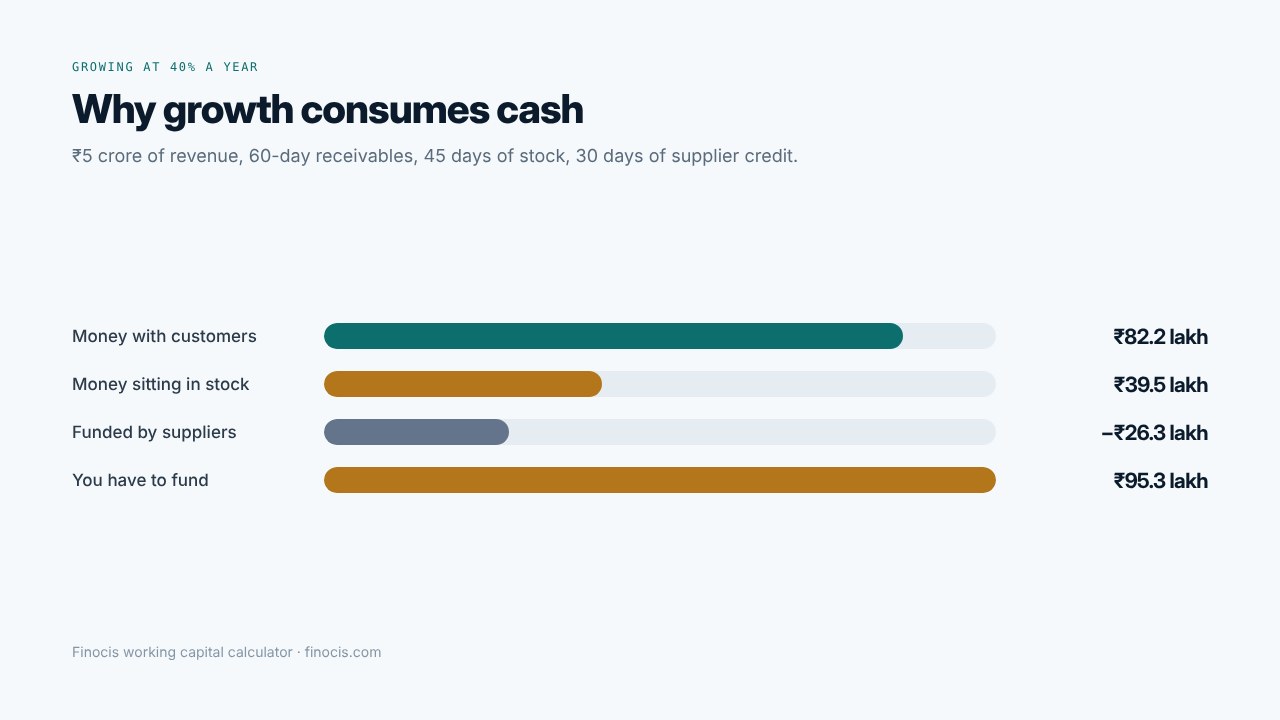
Take a business doing ₹5 crore, collecting in 60 days, holding 45 days of stock and paying suppliers in 30. Roughly ₹95 lakh is tied up in the cycle at any moment. Grow 40% and every one of those numbers grows with it — you need another ₹38 lakh of funding just to run the same business at a larger size.
That money has to come from somewhere: retained profit, an overdraft, or a founder's pocket. The order in which a business discovers this is usually: growth, celebration, panic.
The forecast
Thirteen weeks, because it is long enough to see a problem coming and short enough to forecast honestly. Monthly is too coarse — salaries are due on the 1st and collections land on the 20th, and a monthly view hides that entirely.
One column per week. Rows:
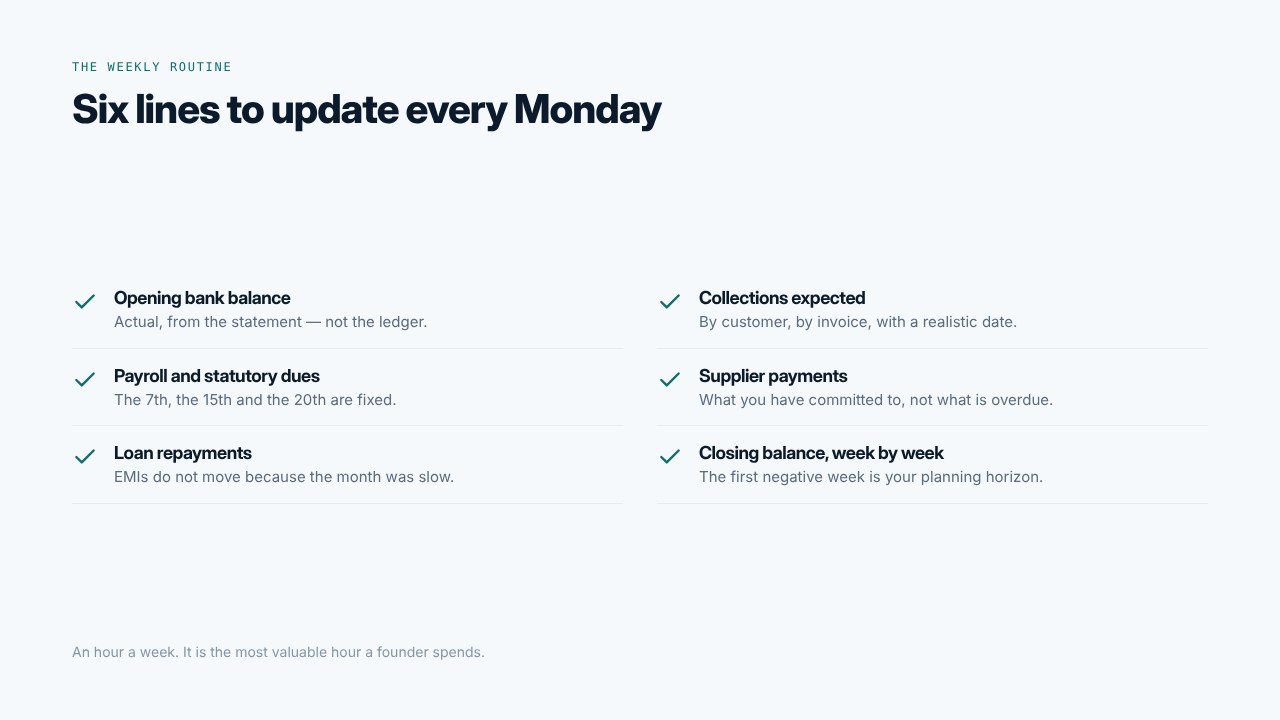
- Opening balance — the actual bank balance, not the ledger balance
- Collections — listed by customer and invoice, each with a realistic date
- Other inflows — loan drawdowns, refunds, capital
- Payroll — including PF and ESI
- Statutory — TDS on the 7th, PF and ESI on the 15th, GST on the 20th
- Suppliers — what you have committed to paying
- Fixed costs — rent, utilities, subscriptions
- Loan repayments
- Closing balance
The output is one number per week. The first week that turns negative is your planning horizon, and everything else is detail.
Collections, honestly
The forecast is only as good as the collection dates, and this is where optimism destroys the exercise.
Use each customer's actual payment history, not the agreed terms. A client whose terms say 30 days and who has paid on day 52 for the last six invoices will pay on day 52 again. Forecasting day 30 because that is what the contract says produces a document that is wrong in a predictable direction.
For anything uncertain, build it in at a probability. A ₹10 lakh invoice from a slow payer, entered at ₹6 lakh, is more useful than ₹10 lakh entered on a date nobody believes.
Levers, in order of cost
Invoice on the day of delivery. Businesses that invoice at month end add an average of fifteen days to every collection, for no reason beyond habit. This is free and immediate.
Take a deposit. On custom work, 30% to 50% up front. It funds the materials and filters out customers who were never going to pay.
Chase the oldest five weekly. Not the whole ledger monthly. Five calls a week, consistently, collects more than a quarterly letter-writing campaign.
Negotiate supplier terms in days, not price. A supplier who will not move on price will often move from 30 days to 45. That is free working capital.
Then look at an overdraft. It is the most expensive option and the first one most businesses reach for. Work out the cycle first — the funding requirement often shrinks enough that the facility is not needed.
Three habits that prevent the crisis
Separate the tax money. GST you have collected is not revenue; it is money you are holding for the government. A second account with the GST and TDS moved into it weekly turns the 20th from a scramble into a transfer.
Know your runway. Cash on hand divided by average monthly net outflow. Under three months, that number should be on your desk every Monday.
Review the forecast against actuals. Each week, compare what you predicted with what happened. The point is not accuracy for its own sake — it is learning how wrong you usually are, and in which direction, so that next quarter's forecast carries that correction.
An hour a week. Almost nothing else a founder does returns as much.