Home/ Finance Guides/ Article
What actually moves your credit score

A credit score is a number between 300 and 900 that decides whether you are offered a loan, and at what rate. Most advice about it is folklore. The bureaus do publish what goes into it, in general terms, and the weightings are lopsided enough to be worth knowing.
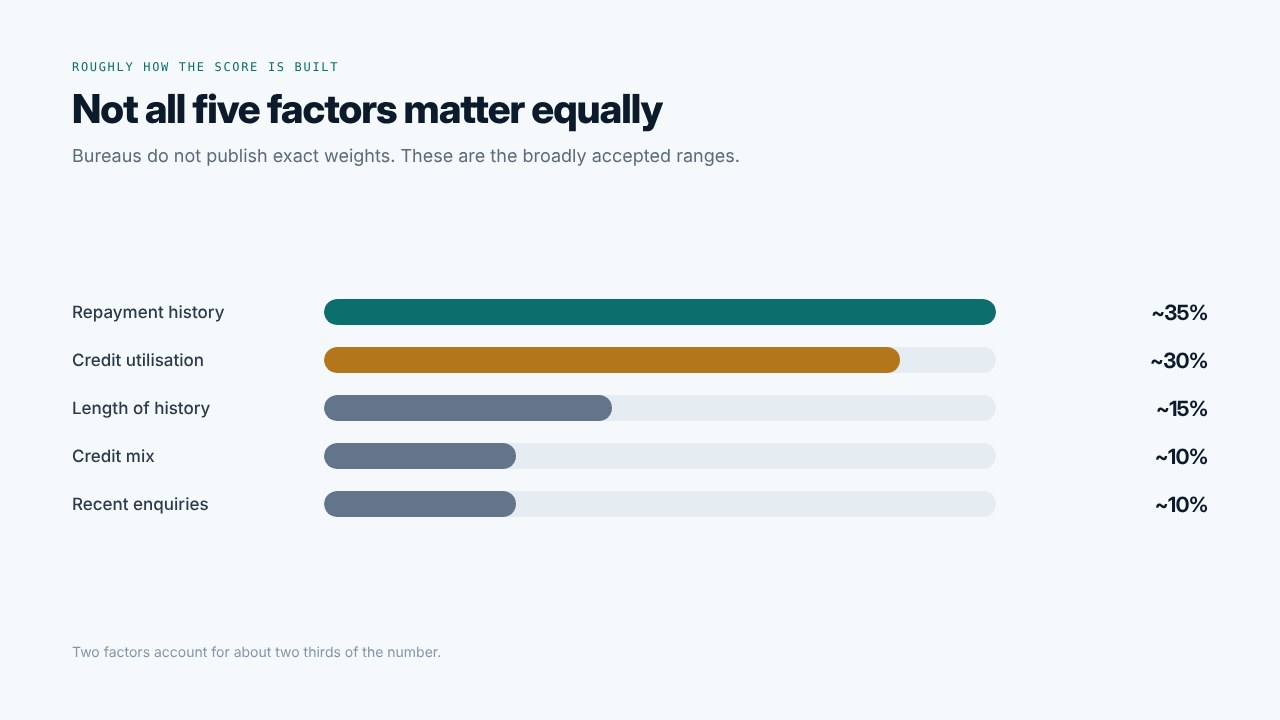
Repayment history — about 35%
Whether you paid on time, on every account, every month. This is the largest single factor and the one with the longest memory.
A payment reported 30 days late stays on your report for years. One missed EMI on a personal loan can cost 50 to 70 points, and the recovery is slow — not because the bureau is punishing you, but because the model needs a run of clean months to outweigh the bad one.
The practical defence is boring: auto-debit on every credit facility, and a buffer in that account. Most late payments are not affordability problems. They are a forgotten due date while travelling.
Credit utilisation — about 30%
The share of your available limit you are actually using. If your cards total ₹5 lakh of limit and you are carrying ₹2 lakh, utilisation is 40%.
Below 30% is comfortable. Above 50% starts to drag. Above 80% is read as distress, even when you clear the balance in full each month.
This is where the timing trips people up. Your issuer reports the balance on the statement date, not after you pay. Spend ₹1.8 lakh on a ₹2 lakh card, clear it in full on the due date, and the bureau still records 90% utilisation for that month. Paying down before the statement generates, rather than before the due date, fixes it.
The advice that backfires
"Close the cards you don't use."
It sounds prudent and it damages the score twice. Closing a card removes its limit, so the same spending becomes a higher share of a smaller total — utilisation rises without you spending a rupee more. And it eventually removes that account's history, shortening your average credit age.
Unless the card charges an annual fee you resent, keep old cards open and use them occasionally so the issuer does not close them for inactivity. The oldest card in your wallet is doing quiet work.
Length of history — about 15%
How long your accounts have been open, averaged. Nothing accelerates this except time, which is why a 24-year-old with perfect repayment behaviour still scores below a 40-year-old with a decade of ordinary accounts.
If you are young and the score matters for a loan in a year or two, open a credit facility now and run it cleanly. A modest card paid in full monthly builds history that cannot be bought later.
Credit mix — about 10%
A blend of secured borrowing (home, car) and unsecured (cards, personal loans) scores slightly better than one kind alone. It is a small factor and not worth taking a loan you do not need in order to improve.
Recent enquiries — about 10%
Every time a lender pulls your report for an application, a hard enquiry is recorded. Several in a short window reads as someone shopping desperately for credit.
Checking your own score does not count. That is a soft enquiry and has no effect, so the once-a-month habit costs nothing.
What does cost is applying to five banks to "see who approves". Use an eligibility check that does a soft pull, narrow it to one or two, then apply.
What it is worth
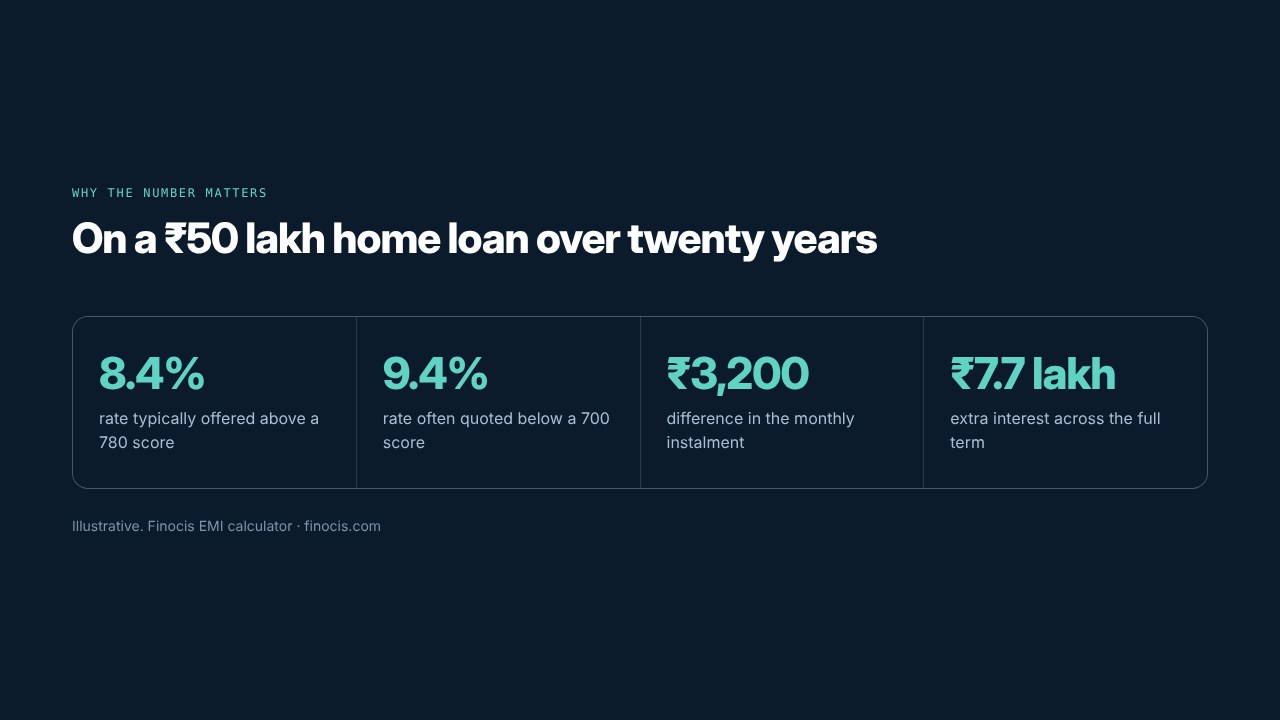
On a ₹50 lakh home loan, the gap between the rate offered to a 780 score and a 690 score is commonly a full percentage point. That is roughly ₹3,200 a month and about ₹7.7 lakh over twenty years. Put your own numbers in and the case for six months of tidying up becomes obvious.
Check the report, not just the score
You are entitled to one free full report a year from each of the four bureaus — CIBIL, Experian, Equifax and CRIF High Mark. Lenders report to different ones, so your score can differ meaningfully between them.
Read the account list rather than the headline number. Errors are common: a loan you closed still showing open, an account that is not yours, a settled account marked written off. Each bureau has a dispute process and is required to investigate within 30 days. Fixing one wrong entry is usually worth more than a year of careful behaviour.