Home/ Capital Gains Tax/ Article
How debt funds, gold and REITs are taxed now
If you last looked at capital gains rules before 2023, almost everything you know about debt funds and gold is now wrong. Two separate rounds of change — the Finance Act 2023 and the July 2024 amendments — rewrote both, and the two changes point in different directions.
Debt funds: the category that lost its advantage
Debt mutual funds used to be the quiet workhorse of a tax-aware portfolio. Hold for three years, pay 20% with indexation, and inflation adjustment meant the effective rate was often in single digits. Fixed deposits could not compete.
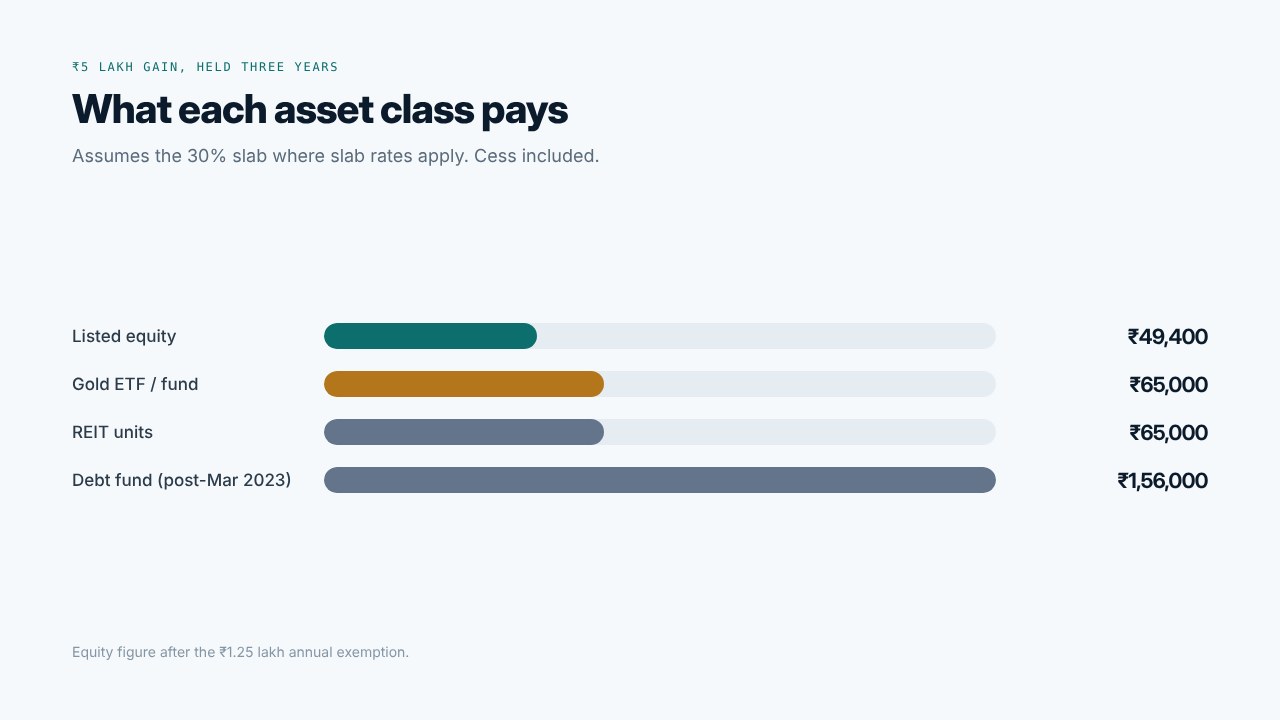
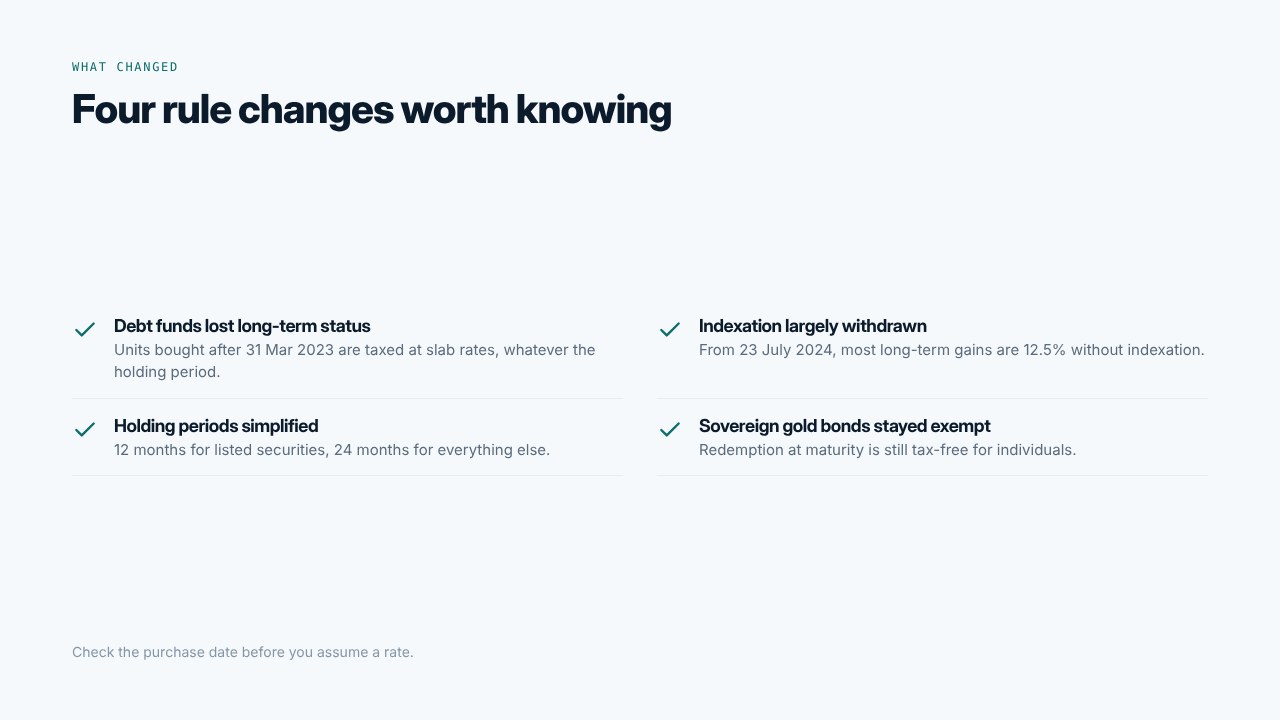
From 1 April 2023 that ended. Units in a fund with less than 35% equity exposure, purchased on or after that date, are taxed at your slab rate regardless of holding period. No long-term category, no indexation, no concession.
At the 30% slab, a debt fund and a fixed deposit now face essentially the same tax. The fund still has advantages — you control the year you realise the gain, and interest is not taxed annually as it accrues — but the structural edge is gone.
Units bought before 1 April 2023 keep the old treatment. If you hold any, check the purchase dates before redeeming. Selling the newer units first, where your platform allows it, can be worth a meaningful amount.
Gold: four wrappers, four outcomes
Gold is where the wrapper matters more than the metal.
Physical gold — jewellery, coins, bars. Long-term after 24 months, taxed at 12.5% without indexation. Short-term gains are added to income at your slab rate. Making charges are not part of the cost for capital gains purposes, which is one reason jewellery is a poor investment vehicle.
Gold ETFs and gold funds — same treatment as physical since the 2024 changes: 12.5% after 24 months. Cheaper to hold, far easier to sell, and no purity or storage question.
Sovereign gold bonds held to maturity — the capital gain on redemption is exempt for individuals. Completely. The 2.5% annual interest is taxable as other income, but the gain itself is not. Nothing else in Indian personal finance offers a tax-free return on a commodity.
Sovereign gold bonds sold on the exchange before maturity — no exemption. Treated like any other listed security: 12.5% after 12 months.
The gap between the third and fourth of those is large and depends entirely on whether you hold to the eight-year maturity or sell early. If you own SGBs, that is the decision worth getting right.
REITs and InvITs: two income streams in one payout
A REIT distribution is not one thing. It arrives as a mixture, and each part is taxed differently:
- Interest — taxable at your slab rate
- Rental income — taxable at your slab rate
- Dividend — exempt if the REIT's underlying companies have not opted for the concessional corporate rate; otherwise taxable at slab
- Return of capital — not taxed on receipt, but it reduces your cost of acquisition, so it increases the capital gain when you eventually sell
That last one catches people. Years of "tax-free" repayment-of-capital distributions quietly erode your cost base, and the bill arrives as a larger capital gain at exit. The REIT publishes the split each year — keep those statements, because reconstructing an adjusted cost base years later is unpleasant.
Capital gains on the units themselves: 12.5% beyond 12 months, 20% below it, the same as listed equity.
Putting it together
Two practical consequences follow from all this.
Asset location matters more than it did. The same money earns a different post-tax return depending on the wrapper it sits in. Debt exposure inside EPF or PPF is untaxed; the same exposure in a debt fund is taxed at slab. For anyone at the 30% slab with long-horizon money, that argues for filling the tax-free vehicles before the taxable ones.
Holding periods need checking, not assuming. Twelve months for listed securities, twenty-four for everything else, and a purchase-date rule sitting underneath for debt funds. Run the specific asset and date rather than working from a rule you remember.
And keep the contract notes. Every one of these rules turns on a date, and the date has to be evidenced.
Read next
 Capital Gains Tax
Capital gains on shares and mutual funds: how the tax is actually computed
Holding period decides the rate, the fund category decides the holding period, and the broker statement rarely decides anything correctly.…