Home/ GST Compliance/ Article
E-way bills: when you need one, and what goes wrong
The e-way bill is a document that must exist before goods move, not after they arrive. That single ordering rule causes most of the trouble, because the commercial instinct is to dispatch first and sort out paperwork later.
When you need one
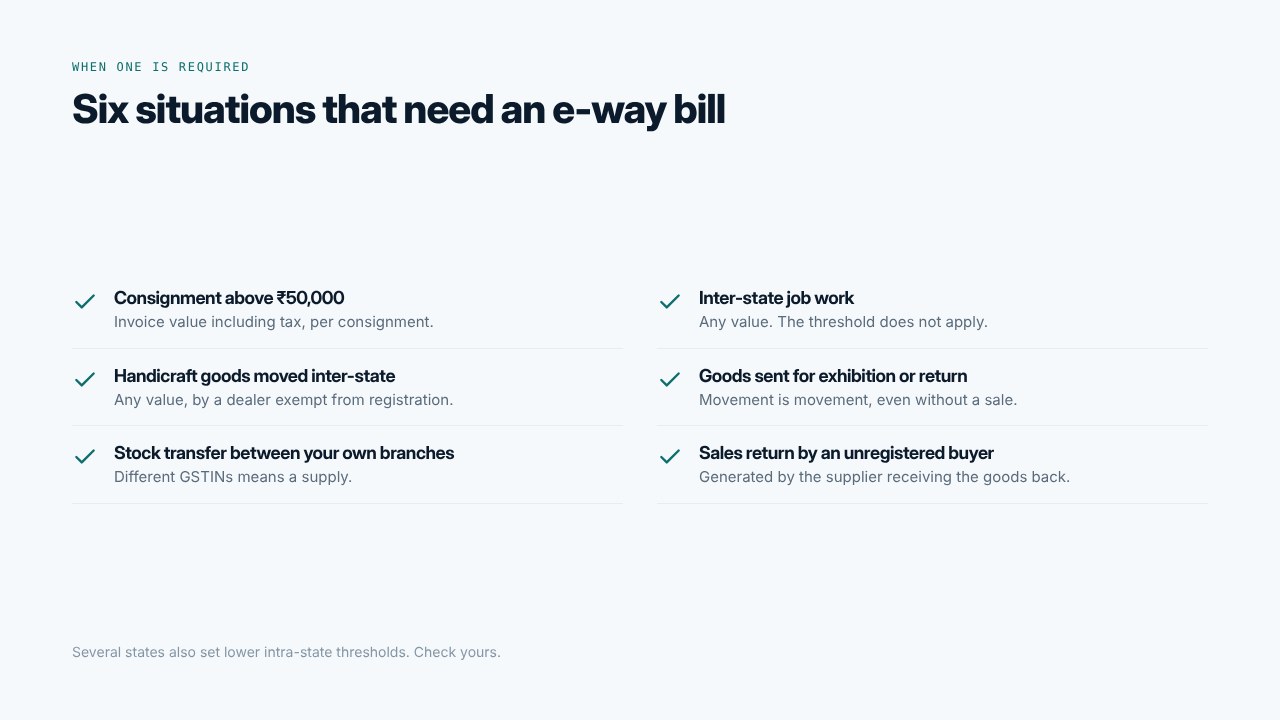
The headline rule: any movement of goods worth more than ₹50,000 requires an e-way bill. That is consignment value including GST, and it applies whether the movement is a sale, a transfer to your own branch, a return, or goods going out for job work.
The exceptions run in both directions. Some movements need a bill at any value — inter-state job work, and handicraft goods moved by a dealer exempt from registration. And several states set a lower threshold for movements within the state, so the ₹50,000 figure is a floor rather than a universal rule. Check your own state's notification.
Who generates it
Usually the supplier. Where the recipient arranges transport, they can generate it. Where neither does and the goods are handed to a transporter, the obligation falls on the transporter.
In practice the supplier should generate it in nearly every case, because the supplier controls the invoice data and bears the consequence when it is wrong. Leaving it to the transporter means leaving your GSTIN on a document you have not seen.
The bill has two parts. Part A carries the invoice details, the GSTINs and the value — this can be filled as soon as the invoice exists. Part B carries the vehicle number, and until Part B is complete the bill is not valid for movement. A Part A generated in the morning and a vehicle loaded at six in the evening is fine; a vehicle on the road with Part B blank is not.
The validity clock
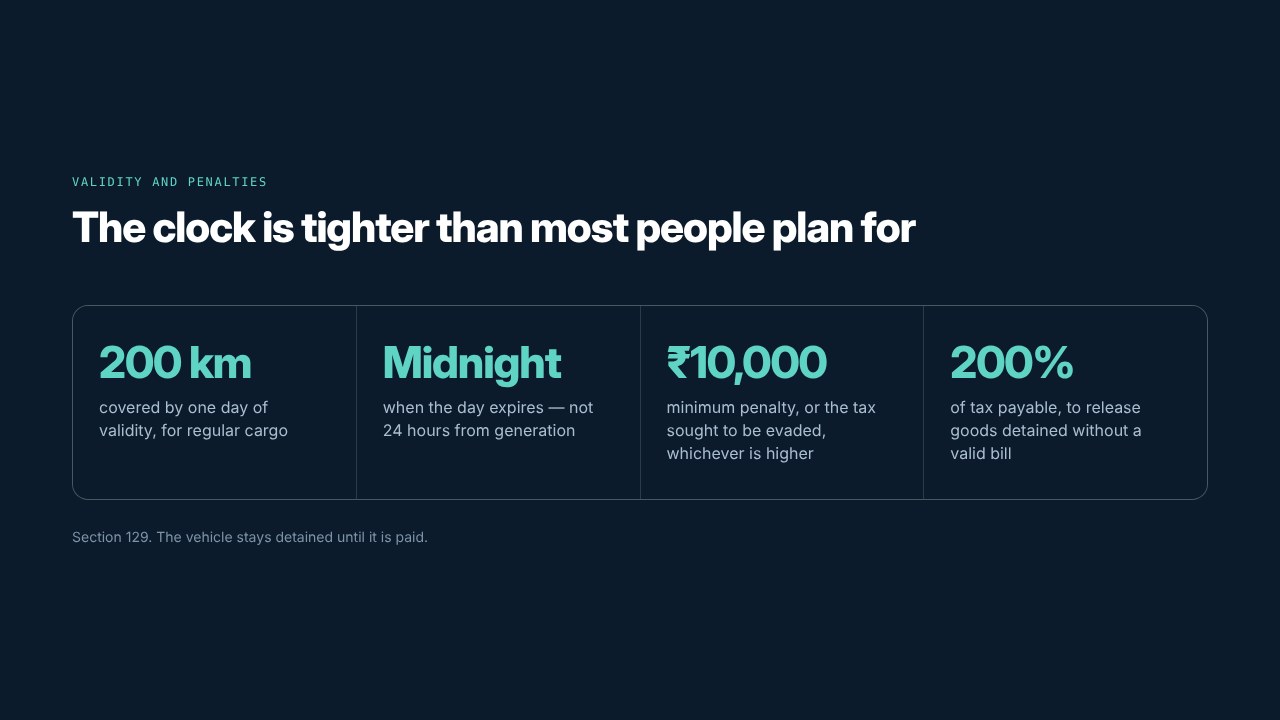
One day of validity per 200 kilometres for regular cargo, and per 20 kilometres for over-dimensional cargo.
The part people get wrong is what "one day" means. It does not mean 24 hours from generation. It expires at midnight at the end of the relevant day. A bill generated at 9pm for a 150 km trip has three hours of validity, not a full day.
Validity can be extended, but only in a narrow window — eight hours before expiry to eight hours after. Outside that window there is no extension, and the only option is a fresh bill, which means explaining why the goods were in transit without a valid one.
What it costs to get wrong
Section 129 provides for a penalty of ₹10,000 or the tax sought to be evaded, whichever is higher. For a consignment of any size, it is the second figure.
Where goods are detained, release requires payment of 200% of the tax payable on them if the owner comes forward — and the vehicle stays where it is until that happens. The real cost is usually not the penalty but the stranded truck, the missed delivery slot and the customer who now wants a discount.
A separate consequence catches businesses that fall behind on returns: fail to file GSTR-3B for two consecutive periods and your ability to generate e-way bills is blocked entirely. For a goods business that is not a compliance inconvenience, it is a full stop. The late fee arithmetic looks very different once dispatch is at stake.
The errors that actually happen
Wrong vehicle number. The lorry breaks down and the goods are transferred to another. Part B must be updated before the new vehicle moves. This is the single most common reason for detention, and it is a two-minute fix that nobody makes at the roadside.
Mismatched values. The invoice says one amount and the e-way bill another. Usually a rounding difference or a freight line included in one and not the other. It looks like concealment to an officer.
Wrong distance. The portal calculates distance from PIN codes and allows a 10% variation. Entering a shorter distance to save a day of validity creates a bill that expires mid-journey.
Cancelled too late. An e-way bill can be cancelled within 24 hours of generation, and only if the goods have not moved. After that it stands, and an unused bill sitting against your GSTIN invites a question about where the goods went.
A workable routine
Generate Part A at the same moment you generate the invoice — the data is identical and the portal accepts a bulk upload from most accounting systems. Fill Part B when the vehicle is actually loaded, not before. Give the driver a printed copy as well as the number; phone signal at a check post is not something to rely on.
And reconcile monthly: e-way bills generated against invoices issued. A gap in either direction is worth understanding before a departmental system notices it for you.
Read next
 GST Compliance
The GST compliance calendar, and what missing one month actually costs
A single missed GSTR-3B does not stay a single problem. Returns must be filed in sequence, so one gap blocks…