Home/ Financial Planning/ Article
Fixed or floating: which home loan rate actually costs less
Ask a bank which to take and you will be told floating, because that is what they mostly sell. Ask someone who took a loan in 2021 and watched their tenure stretch by four years, and you will hear something else. Both answers are about temperament rather than arithmetic, and the arithmetic is worth doing.
What each one actually is
A floating rate is tied to an external benchmark — for almost all home loans now, the RBI's repo rate — plus a spread the bank sets at sanction. When the repo moves, your rate moves within three months. The spread is supposed to stay fixed for the life of the loan.
A fixed rate does not move. In India, though, read the sanction letter carefully: many so-called fixed loans are fixed for two, three or five years and then convert to floating. Genuinely fixed-for-the-full-term products exist but are uncommon, and they are priced accordingly.
The premium, as a number
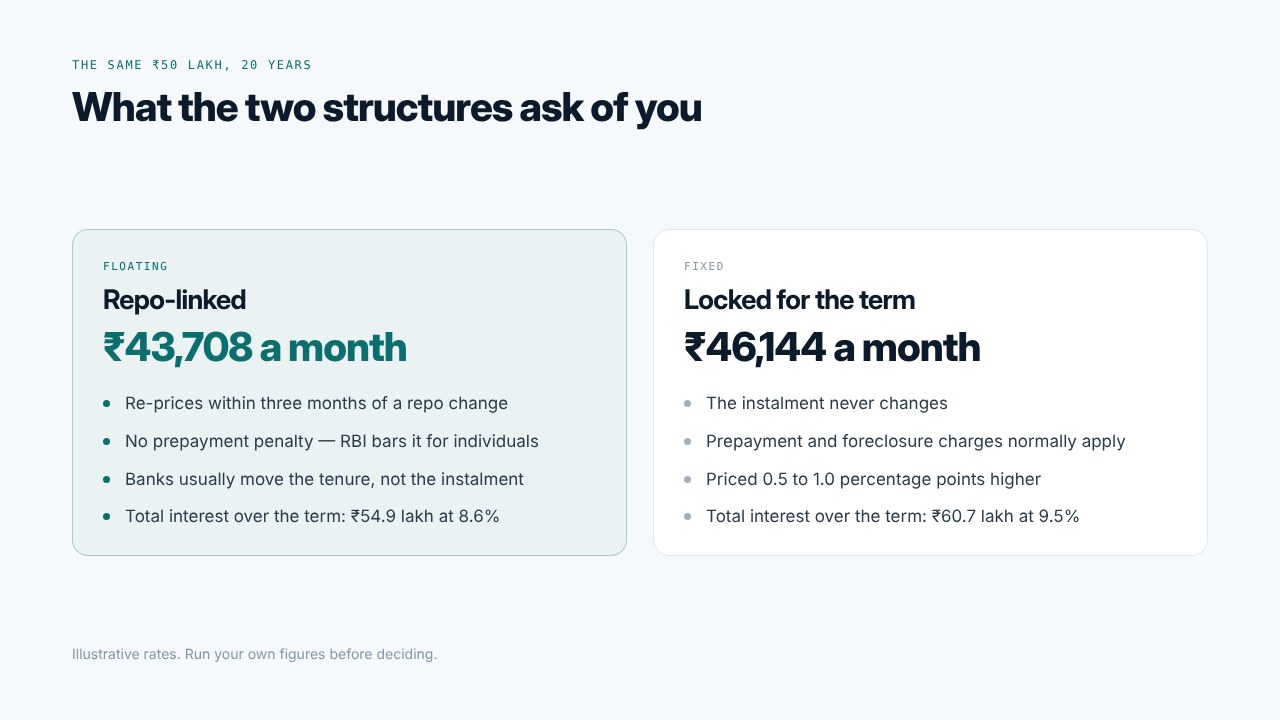
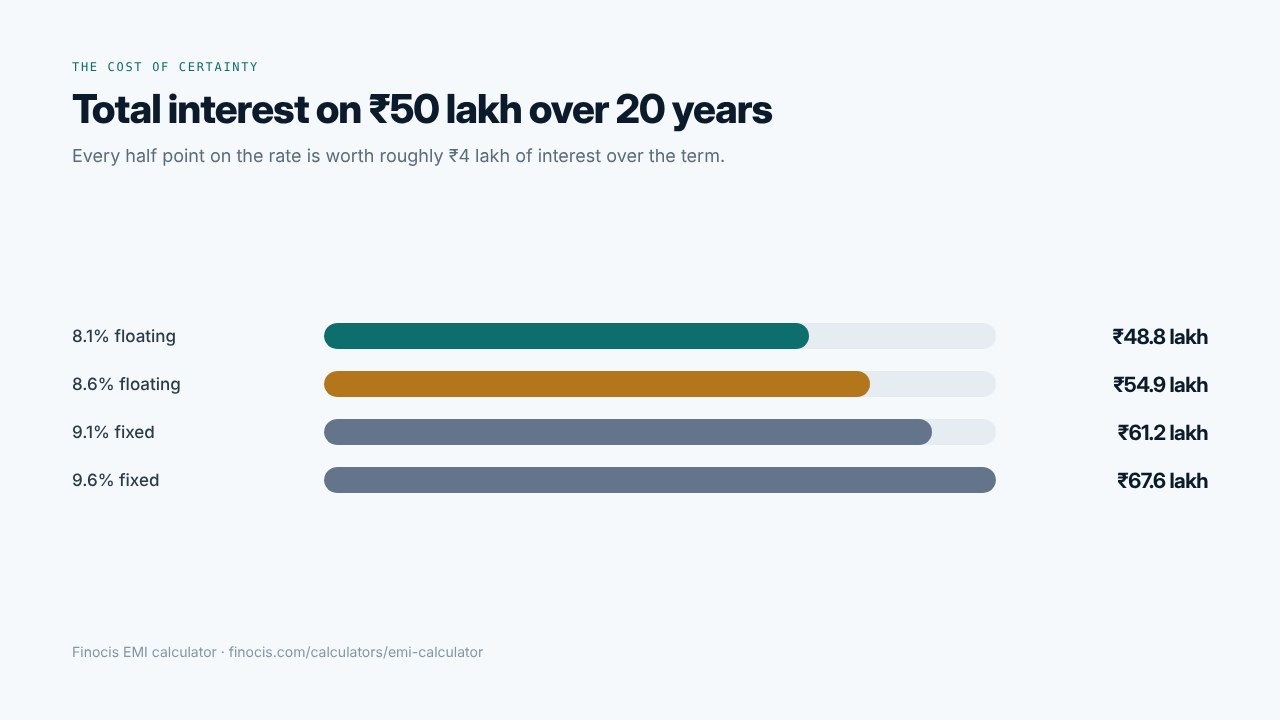
Fixed rates in India typically sit 0.5 to 1.0 percentage points above floating. On ₹50 lakh over twenty years, each half point is worth roughly ₹4 lakh in total interest.
So a fixed rate one full point higher costs about ₹8 lakh more over the term. That is the insurance premium. The question is whether you expect rates to rise by more than a point, on average, across twenty years — and nobody knows that, including the bank quoting you the fixed rate. They price it to win either way.
The thing nobody mentions about floating rates
When the repo rises, most banks do not raise your EMI. They extend the tenure instead.
This feels generous and is not. Your monthly outgo looks unchanged, so nothing prompts you to react, while the total interest climbs quietly. Borrowers who took twenty-year loans in 2021 and never checked found, by 2024, that they were on twenty-five or twenty-eight year loans — and some had tenures notionally running past retirement.
After any rate change, ask your bank in writing which they adjusted and request the revised amortisation schedule. If the tenure moved and you can afford the higher instalment, ask them to raise the EMI and restore the original term. It costs nothing and it is the single most valuable phone call available to a floating-rate borrower.
The prepayment asymmetry
This is the part that usually settles it. The RBI bars lenders from charging a prepayment or foreclosure penalty on floating-rate home loans to individuals. Fixed-rate loans carry no such protection, and charges of 2% to 4% of the outstanding amount are normal.
That matters because most home loans do not run their full term. People prepay from bonuses, sell and move, or refinance. A floating loan lets you do all three for free. A fixed loan charges you for the privilege, at exactly the moment you have the money.
If you expect a bonus, an inheritance or a property sale during the loan, work out what prepaying would save before you lock into a structure that penalises it.
When fixed genuinely makes sense
- Your budget has no slack. If a two-point rate rise would mean genuine hardship rather than inconvenience, certainty is worth paying for. That is insurance, and insurance always costs more than its expected value.
- The gap is unusually narrow. When fixed is within 0.25 points of floating — which happens when banks expect rates to fall — the premium is small enough to be worth taking.
- A short remaining term. With five or six years left, rate movements have little left to act on and predictability costs almost nothing.
The hybrid, and why it disappoints
Fixed for three years, floating after. It sounds like the best of both and is mostly the worst: you pay the fixed premium during the period when rate risk is lowest and predictable, then float for the years when it actually matters. Read the reset clause before signing, because the spread applied at conversion is sometimes not the one you were quoted.
What to do
For most borrowers, floating is the right answer — not because rates will fall, but because of the prepayment rule. The freedom to clear the loan early, without penalty, at any moment, is worth more than the rate difference for anyone whose income is likely to grow.
Then do two things people skip. Check your spread once a year: banks offer new customers a better one than you are paying, and a small conversion fee usually resets it. And after each repo change, insist on the revised schedule, so you can see whether the EMI or the tenure moved. The schedule is where the real cost of a loan is visible, and it is the one document borrowers almost never ask for.
Read next
 Financial Planning
A financial plan that fits on one page
Most plans fail because they are too complicated to follow. Six decisions, in order, cover almost everything that matters.