Home/ GST Filing/ Article
What a GST invoice has to say, and what happens when it does not
An invoice under GST is not a commercial document that happens to show tax. It is a statutory document, and its contents are prescribed. Get a field wrong and the consequence usually lands on your customer, which is a worse problem than it landing on you.
The fields
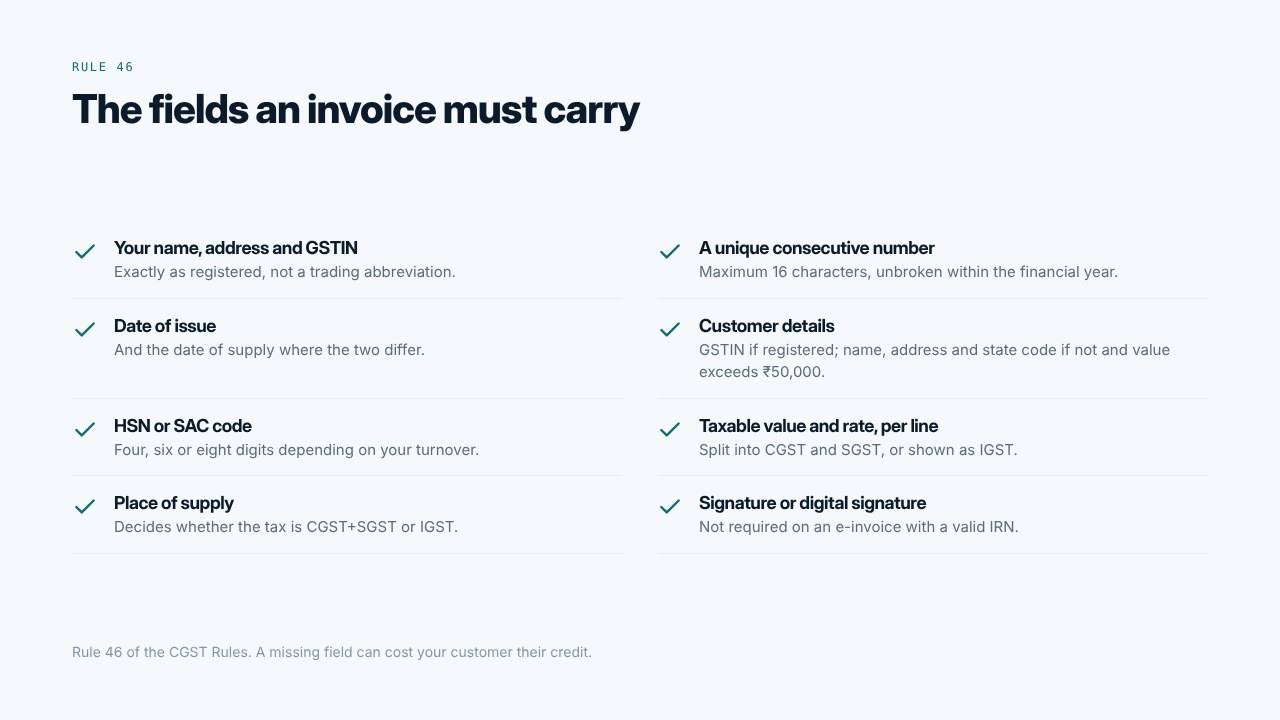
Rule 46 lists sixteen particulars. In practice the ones that cause trouble are these.
Your GSTIN, exactly as registered. Not the trading name, not an abbreviation. If your customer's accounts team cannot match the number, the invoice does not reconcile.
A unique, consecutive serial number. Maximum sixteen characters, letters, numbers, hyphens and slashes only. It must be consecutive within the financial year — no gaps, no restarts in the middle, no reuse. Multiple series are permitted if each is itself unbroken, which is how branches and verticals handle it.
HSN or SAC code. How many digits depends on turnover: four for businesses under ₹5 crore, six above it, eight for exports. Getting the code itself wrong is a classification question with tax consequences; getting the number of digits wrong is a compliance one.
Place of supply. This decides whether the transaction is intra-state or inter-state, and therefore whether you charge CGST plus SGST or IGST. Charge the wrong one and the customer cannot use the credit — the ledgers do not interchange. The correction is a credit note and a fresh invoice, which is an awkward conversation.
When it has to be issued
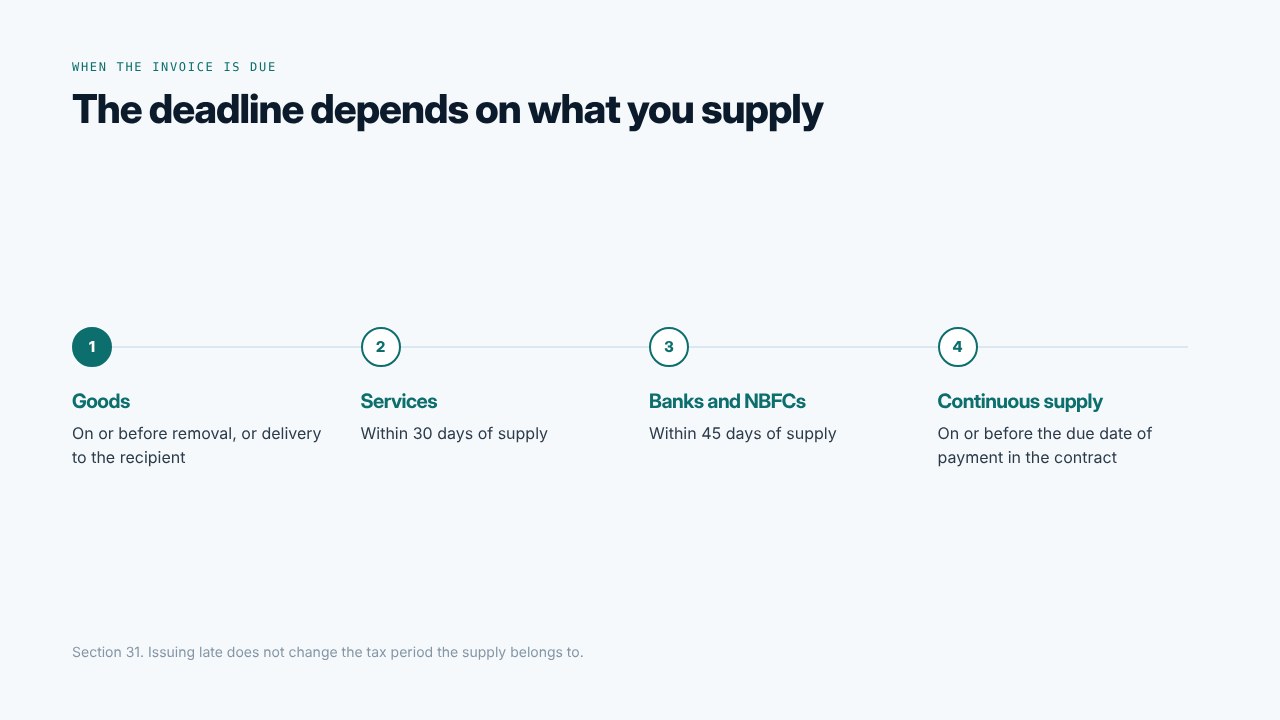
For goods: on or before removal, or delivery. For services: within 30 days of supply — 45 for banks and NBFCs. For continuous supply, on or before the due date for payment under the contract.
Issuing late does not move the supply into a later period. The liability still belongs to the month the supply happened, so a January service invoiced in March is a January liability, with interest running from the January due date.
E-invoicing
Businesses above the notified turnover threshold must register each B2B invoice with the Invoice Registration Portal and obtain an Invoice Reference Number and a QR code before issuing it.
The threshold has moved steadily downward since e-invoicing began, so a business that was outside it last year may be inside it now — the test is aggregate turnover in any financial year since 2017-18, not just the current one. Crossing it once brings you in permanently.
An invoice that should carry an IRN and does not is not a valid tax invoice. Your customer cannot claim credit against it, and it will not auto-populate into their GSTR-2B. That is discovered weeks later, during reconciliation, when the amount has already been paid.
The documents around the invoice
Bill of supply — issued instead of a tax invoice for exempt supplies, or by a composition dealer. It carries no tax, and a composition dealer must state on it that they cannot collect tax.
Credit note — for a reduction after issue: a return, a rejection, an overcharge. It must be declared no later than 30 November following the end of that financial year, or the annual return, whichever is earlier. Past that date the tax cannot be recovered.
Debit note — for an increase. No time limit on issuing, but it affects your customer's credit window.
Delivery challan — for movement that is not a supply: job work, goods on approval, transport in knocked-down condition.
Where it goes wrong in small businesses
Gaps in the series. A cancelled invoice deleted from the system rather than marked cancelled. The gap is visible in any audit and has to be explained.
Two series running by accident. One from the accounting software and one from a hand-written book for cash customers, both starting at 001.
Rounding each line. Round the invoice total, not every line. Line-by-line rounding is what causes your GSTR-1 to drift from your books by a few rupees every month.
Wrong customer GSTIN. A single mistyped character and the invoice lands in nobody's 2B. Validate the number when you set the customer up, not when the credit fails.
Most of these are five-minute fixes at the point of issue and multi-hour reconciliations nine months later. The invoice is the cheapest place in the GST system to be careful.