Home/ Tax Planning/ Article
PPF, ELSS or NPS: picking between the three main 80C options
Every January the same question arrives: PPF, ELSS or NPS. The usual answer compares returns, which is the least useful way to choose between them, because the three products are not really competing for the same money.
What each one is
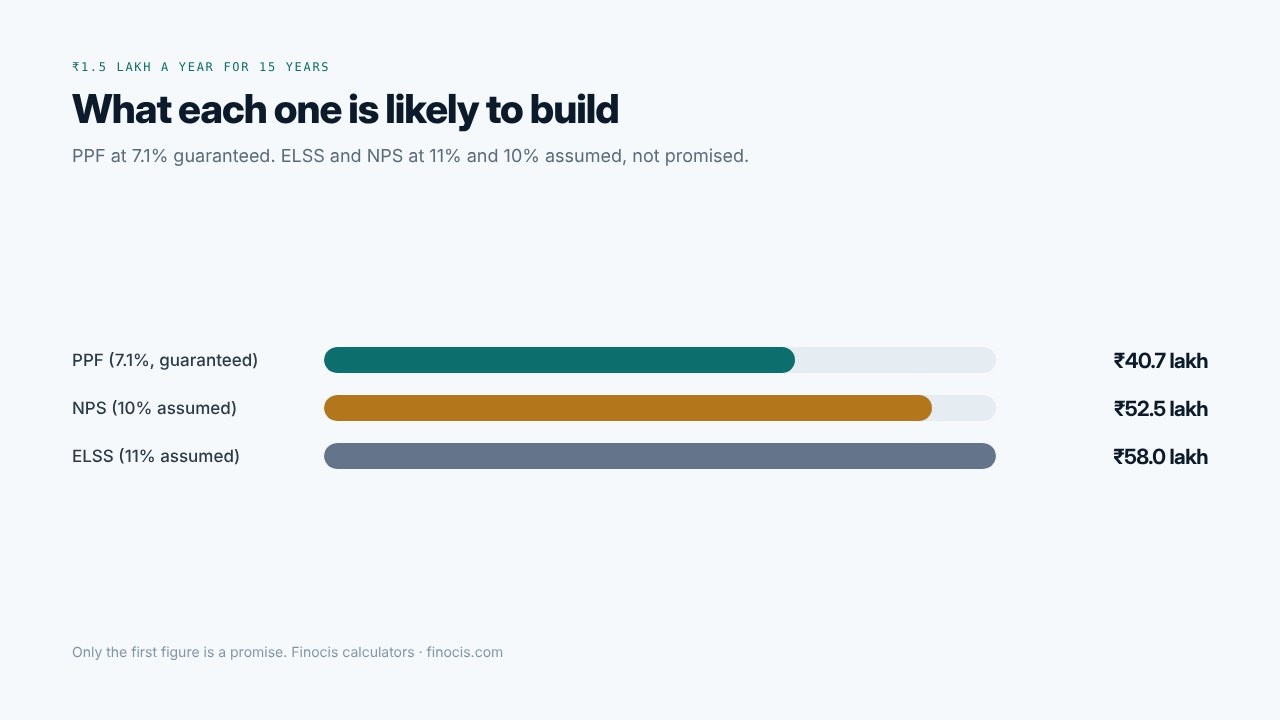
PPF is a fifteen-year government-backed account currently paying 7.1%, compounded annually, and exempt at every stage — contribution, interest and maturity. The rate is reviewed quarterly, so it is guaranteed in the sense that it will be paid, not in the sense that it will stay at 7.1%.
ELSS is an equity mutual fund with a three-year lock-in on each instalment. No guarantee of anything. The shortest lock-in of any 80C option, which also makes it the one people most often misuse.
NPS is a retirement account that runs until you turn 60. You choose the equity-debt mix. At exit, at least 40% must buy an annuity; the rest comes out tax-free.
The thing that actually separates them
Not returns — liquidity.
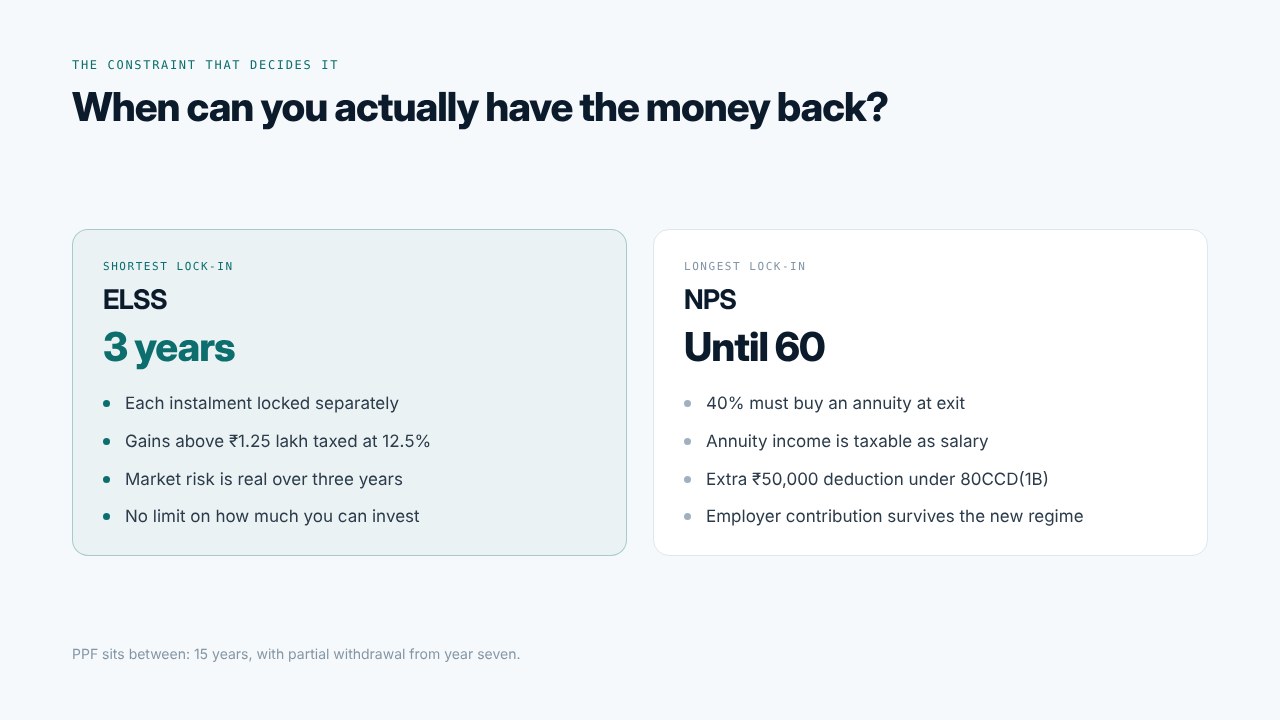
ELSS gives your money back in three years. PPF gives partial access from the seventh year and full access at fifteen. NPS gives almost nothing back until 60, and even then holds 40% hostage to an annuity.
So the question is not "which pays more" but "when do I need this money, and what happens if I need it sooner than I planned". A 28-year-old putting money into NPS is making a 32-year commitment. That can be exactly right, and it can be a mistake that only becomes visible at 38.
The case for each
PPF suits the stable, guaranteed portion of a long-horizon portfolio. At the 30% slab its tax-free 7.1% is equivalent to a taxable deposit paying over 10%, which nothing safe offers. It is also the right home for money you want protected from your own decisions — the lock-in is a feature.
One detail worth the effort: interest is calculated on the lowest balance between the 5th and the end of each month. Deposit before the 5th of April and you earn a full year on the full amount. Over fifteen years that timing alone is worth a meaningful sum. The year-by-year table makes the difference visible.
ELSS suits someone who was going to invest in equity anyway and wants the deduction on top. The three-year lock-in is short enough that it does not distort your plan.
The trap is treating three years as the investment horizon. Equity can be down 30% at the end of three years. Think of the lock-in as a legal minimum and the sensible horizon as seven years or more. If you cannot commit to that, the equity exposure is the wrong call, not the fund.
NPS suits people who want the extra ₹50,000 deduction under 80CCD(1B), which sits on top of the ₹1.5 lakh under 80C and is the only straightforward way to extend the limit.
The annuity requirement is the real cost. Annuity rates in India have run around 6% to 7%, below what the corpus was earning, and the pension is taxable as salary while the lump sum is not. Take the minimum 40% into annuity unless you specifically want guaranteed lifelong income.
There is one piece of NPS that stands apart: the employer contribution under 80CCD(2) is deductible and survives the new regime, which almost nothing else does. If your employer offers it, that is worth structuring for regardless of which regime you file under.
How they come out after tax
PPF is fully exempt. NPS is exempt on the lump sum, taxable on the annuity. ELSS gains above ₹1.25 lakh a year are taxed at 12.5% on redemption.
That makes the comparison narrower than the gross return figures suggest. An ELSS at 11% and a PPF at 7.1% are closer after tax than they look, particularly once you account for the certainty of one and not the other.
The question before all of this
Does the deduction do anything for you at all?
Under the new regime, 80C and 80CCD(1B) are both unavailable. Only the employer's NPS contribution under 80CCD(2) survives. Locking ₹1.5 lakh into a fifteen-year account for a deduction you cannot claim is simply locking up ₹1.5 lakh.
Settle the regime first. Then, if the old regime is genuinely cheaper, count what your EPF and home loan principal are already using before deciding how much of the limit is actually left to fill.
A reasonable default
For most salaried people under 40 on the old regime: EPF and home loan principal fill part of 80C automatically. Put the remainder into ELSS if your equity allocation has room, PPF if it does not. Add the ₹50,000 NPS only if you are comfortable with money you will not see before 60.
And do it in April, not March.
Read next
 Tax Planning
Section 80C is not a strategy: what to actually do before 31 March
Every March, lakhs of people buy an insurance policy they do not want to save tax they may not owe.…