Home/ Tax Saving/ Article
Section 80D: what the deduction actually covers
Section 80D is the deduction people under-claim most, and the reason is that almost everyone has heard the figure ₹25,000 and stopped there. The section is built in two halves, and there is a third piece bolted on that nobody mentions.
The two halves
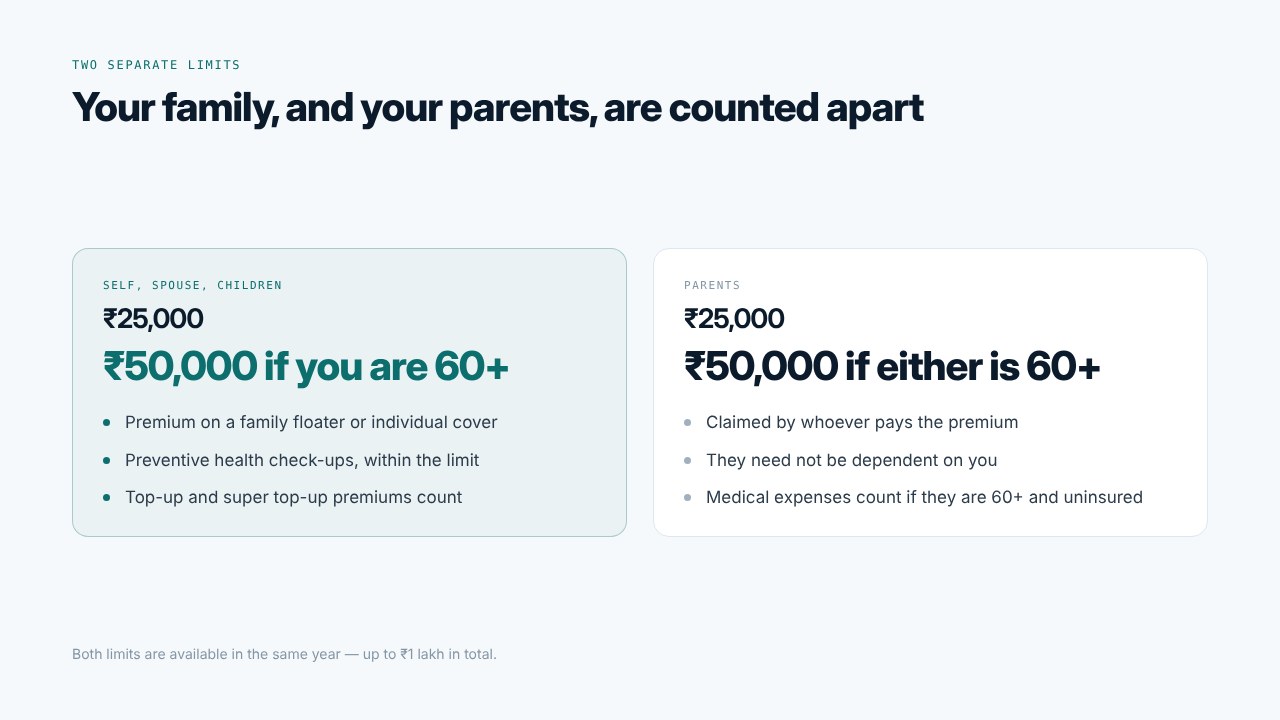
The first covers health insurance for you, your spouse and your dependent children: up to ₹25,000 a year, or ₹50,000 if the eldest person insured under it is 60 or above.
The second covers premiums you pay for your parents: another ₹25,000, or ₹50,000 if either parent is 60 or above. Your parents do not have to be dependent on you, and they do not have to live with you. What matters is that you paid.
Both are available in the same year. A forty-year-old paying ₹22,000 for a family floater and ₹38,000 for a policy covering parents aged 68 claims ₹60,000 — not ₹25,000.
At the 30% slab, that difference is worth about ₹10,900 of tax. It is the single most-missed deduction in Indian personal tax, and it is missed because of a number people half-remember.
The piece nobody mentions
Preventive health check-ups qualify under 80D, up to ₹5,000 for the family — and uniquely in this section, they can be paid in cash.
The catch is that the ₹5,000 sits inside the ₹25,000, not on top of it. If your premium alone is ₹25,000, the check-up adds nothing. If your premium is ₹18,000, a ₹5,000 check-up takes your claim to ₹23,000.
A full-body package at a diagnostic chain costs ₹3,000 to ₹6,000 and is the only line in the Income Tax Act that effectively pays you to have a blood test.
Parents over 60 without insurance
Insurers price cover for an uninsured 72-year-old out of reach, or decline it. The Act allows for this: where a parent is 60 or above and has no health policy at all, actual medical expenditure qualifies instead, up to ₹50,000.
Consultations, hospitalisation, medicines and diagnostics all count. Two conditions: the parent must genuinely have no health insurance, and the spending must be paid other than in cash. Keep the invoices and the bank statement together.
For a family managing a parent's chronic condition out of pocket, this is often a ₹50,000 deduction sitting unclaimed because nobody realised medical bills could be claimed at all.
Where claims fail
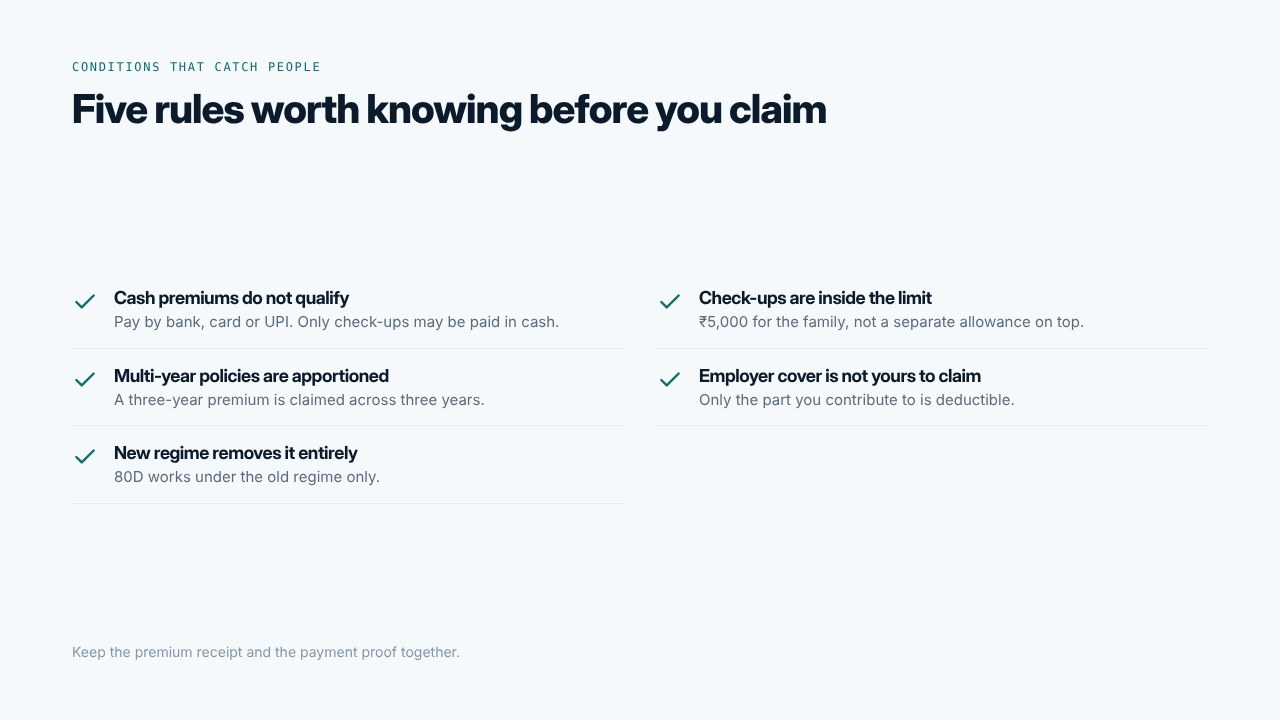
Paid in cash. Premiums must be paid through a banking channel — net banking, card, UPI, cheque. A premium handed to an agent in notes does not qualify, whatever receipt they write. Only preventive check-ups are exempt from this rule.
Claiming your employer's group cover. If your employer pays the premium, there is nothing for you to deduct. Where you top up the corporate floater and the contribution is shown separately on your payslip, that portion is yours to claim.
Multi-year policies claimed in one go. Pay ₹60,000 for three years of cover and you claim ₹20,000 a year, not ₹60,000 now. Insurers' discounts on multi-year policies are real, but the deduction is apportioned.
Siblings and in-laws. The section covers self, spouse, children and parents. Premiums for a brother, a sister or parents-in-law do not qualify, however much you are the one paying.
The regime question again
None of this exists under the new tax regime. 80D, like 80C and HRA, is an old-regime deduction only.
That does not mean skip the insurance — the cover is worth having regardless, and a hospital bill does not care which regime you filed under. It means the tax benefit should not be the reason you buy it, and it should not be the reason you choose a regime either. Work out both bills first, then see whether the deduction changes the answer.
A sensible structure
For most households: a family floater of ₹10 lakh or more, a super top-up of ₹25 lakh above it, and a separate policy for parents rather than adding them to the floater — adding a 65-year-old to a family floater re-prices the whole policy on their age.
That combination usually lands between ₹35,000 and ₹60,000 a year for a family of four with parents in their sixties, which sits comfortably inside the combined 80D limits. The cover is the point. The deduction is a discount on something you needed anyway.