What a statutory audit actually looks at
The first statutory audit is unsettling, mostly because nobody explains what is being tested. The assumption is that someone will examine every voucher and find the mistakes. That is not what happens, and understanding what does happen makes the process far less painful.
What an auditor is actually testing
An audit opinion says the financial statements give a true and fair view. To support that, the auditor tests a set of assertions about each material balance:
- Existence — the stock on the balance sheet is really in the warehouse
- Completeness — every liability that should be recorded is recorded
- Valuation — the debtor balance is actually collectible at that figure
- Rights and obligations — the asset belongs to the company
- Cut-off — the sale went into the right year
- Presentation — it is disclosed under the right head
Everything an auditor asks for maps to one of those. A request for a bank confirmation is existence. Walking the warehouse is existence. Reviewing post-year-end collections is valuation. Testing the last ten invoices of March and the first ten of April is cut-off.
Materiality governs the whole exercise. A threshold is set — commonly a small percentage of turnover or profit — and anything below it is not individually examined. The audit is not looking for every error. It is forming an opinion on whether the statements are materially right.
Where small companies get stuck
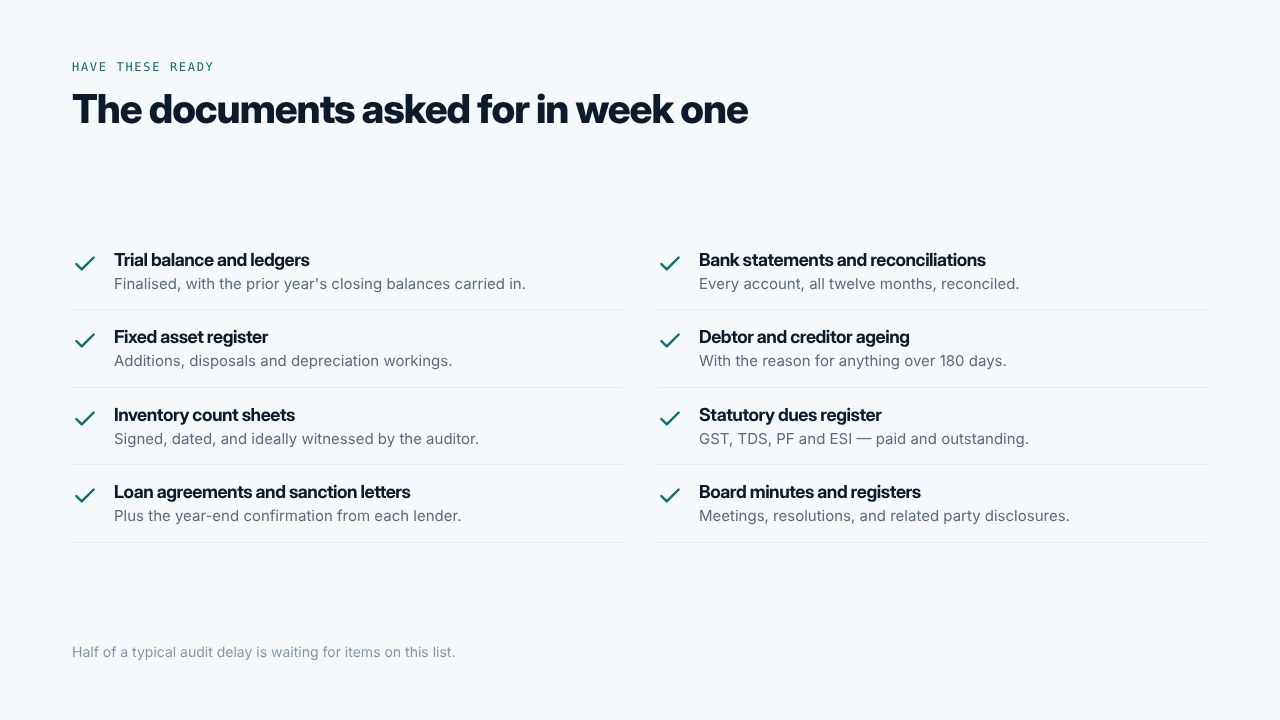
Cash. A large cash balance at year end that nobody physically counted. Count it, record the denominations, have someone sign the sheet.
Director's current account. Personal expenses mixed into business ledgers. Every statutory audit finds this and every one asks the same questions. Keeping a clean director's account from day one removes an entire line of enquiry — it is the main argument for setting the chart of accounts up properly at the start.
Inventory. If stock is material, the auditor should attend the physical count. That has to be scheduled before the year end, not negotiated after it. A count the auditor did not witness can only be verified indirectly, and that weakens the opinion.
Related party transactions. Sales to a company your brother owns, rent paid to a director, a loan from a relative. All disclosable. Auditors find them through bank narrations and ledger names, so volunteering them is always better than having them discovered.
Statutory dues. Unpaid GST, TDS, PF or ESI at year end must be disclosed in the auditor's report under CARO. Amounts outstanding beyond six months are reported specifically, and lenders read that paragraph.
Statutory audit, tax audit, GST audit
They get conflated constantly and they are different obligations.
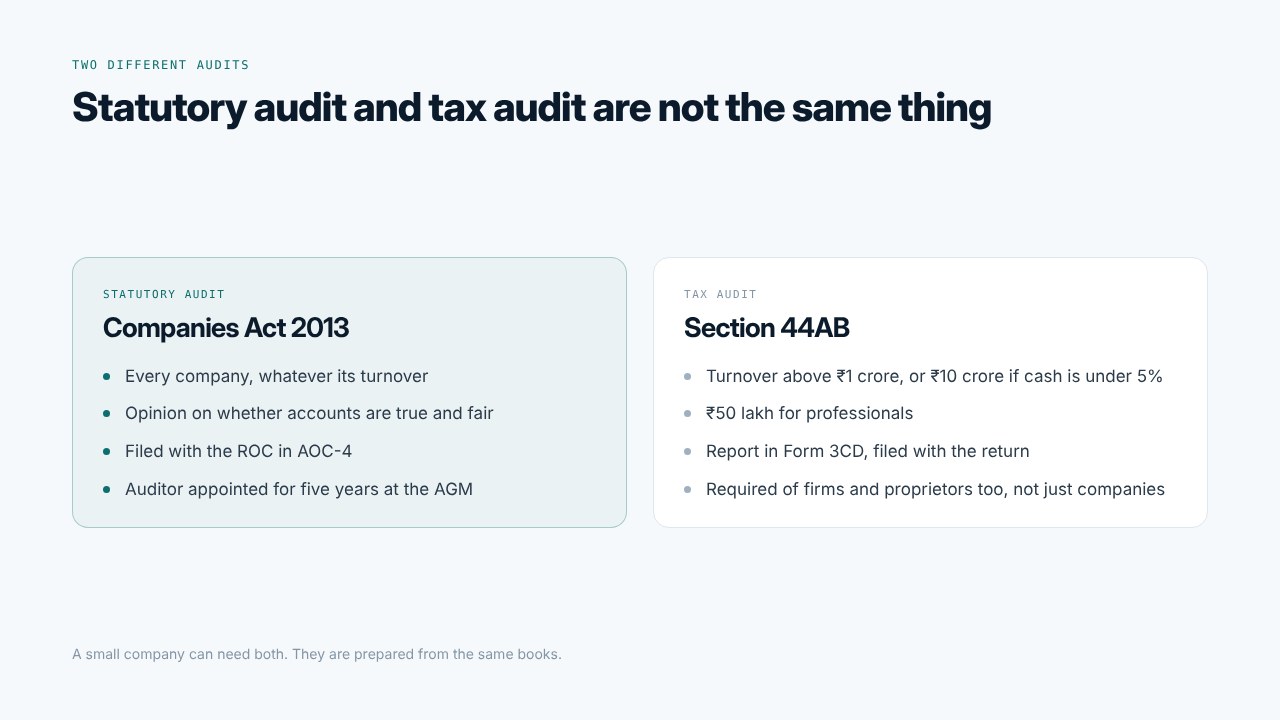
Statutory audit is required of every company under the Companies Act, whatever its size, including a dormant one. The auditor is appointed for five years at the annual general meeting, and the report is filed with the ROC in AOC-4.
Tax audit under section 44AB applies on turnover — above ₹1 crore, or ₹10 crore where cash receipts and payments are each within 5% of the total, and ₹50 lakh for professionals. It applies to proprietors and firms as well as companies. The output is Form 3CD, filed with the income tax return.
GSTR-9C is a reconciliation statement, not strictly an audit since the certification requirement was removed, required above ₹5 crore of turnover.
A small private company past the turnover thresholds needs all three, prepared from the same set of books.
Reading the opinion
Unmodified — the accounts are true and fair. What you want.
Qualified — true and fair except for a specific item. Lenders and investors read the exception closely.
Adverse — the accounts are not true and fair. Rare and serious.
Disclaimer — the auditor could not obtain enough evidence to form an opinion. Usually a records problem, and arguably worse than a qualification because it says nothing can be relied on.
There is also an emphasis of matter paragraph, which is not a qualification. It draws attention to something properly disclosed — a going concern uncertainty, significant litigation — without changing the opinion.
Making it shorter
Close the books monthly rather than reconstructing the year in October. Reconcile every bank account every month. Keep a schedule behind every balance sheet line, so that when the auditor asks what makes up ₹14.2 lakh of advances, there is a list rather than an afternoon of digging.
Most of what makes a first audit painful is not scrutiny. It is the three weeks spent assembling records that should already have existed.