Home/ Payroll Accounting/ Article
Why your January salary drops, and what to do about it
Every January, payroll teams across India field the same question in slightly different words: what happened to my salary?
Nothing happened to your salary. Your gross is unchanged. What changed is the tax coming out of it, and the reason is a promise you made in April.
How the estimate works
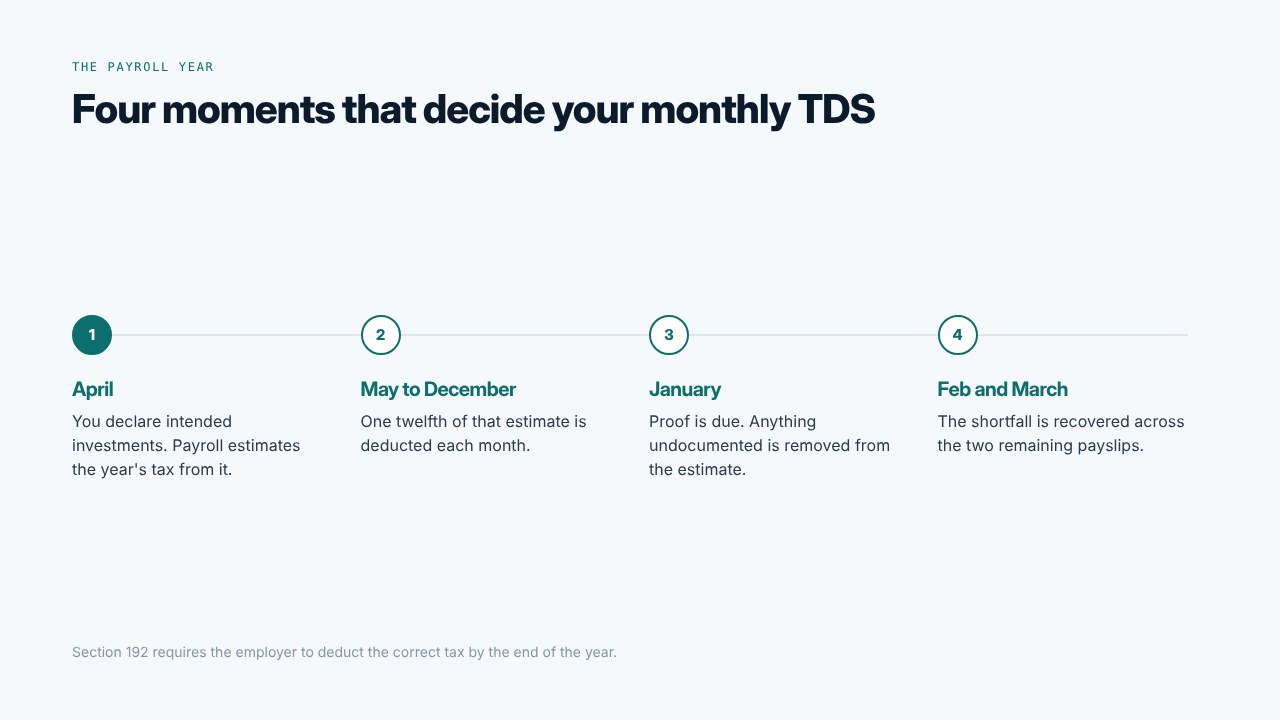
Section 192 requires your employer to deduct the right amount of tax on your salary by the end of the financial year — not approximately, and not on average. To spread it evenly, payroll estimates your annual liability in April and deducts a twelfth of it each month.
That estimate is built on what you declared: the regime you chose, the 80C investments you intended to make, the health premium you planned to pay, the rent you said you would pay. Nobody verifies any of it in April. It is a statement of intent, and payroll takes it at face value because it has to in order to compute anything at all.
What January is for
Somewhere between early December and late January, payroll asks for proof. Rent receipts with the landlord's PAN if your rent exceeds ₹1 lakh a year. The PPF passbook. The ELSS statement. The insurance premium receipt. The home loan interest certificate.
Whatever you cannot prove is removed from the estimate. The annual liability is recomputed on what is left, and the gap between what has been deducted so far and what should have been deducted now has to come out of the payslips that remain.
There are two of them.
The arithmetic
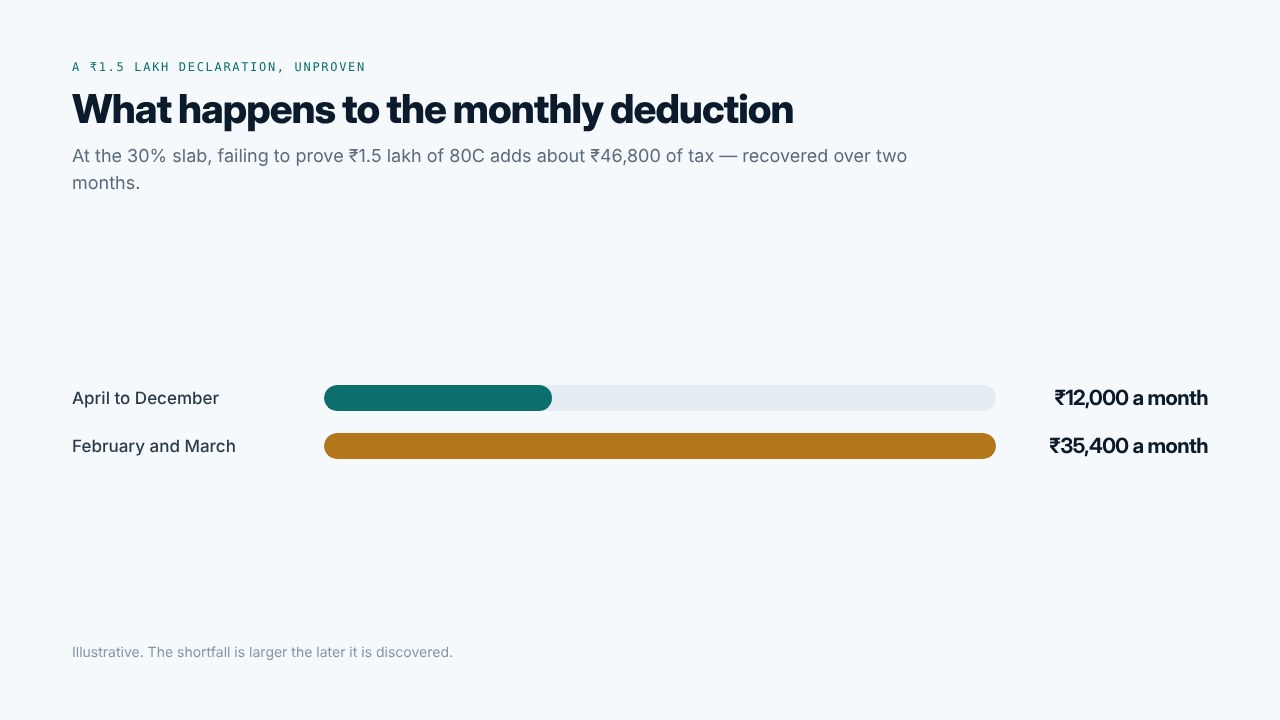
Suppose you declared ₹1.5 lakh of 80C in April and proved none of it. At the 30% slab, that declaration was reducing your estimated tax by about ₹46,800 including cess. Payroll has therefore under-deducted by roughly ₹3,900 a month for ten months — about ₹39,000.
That ₹39,000, plus the correct deduction for the remaining months, now lands across February and March. A deduction that was ₹12,000 a month becomes ₹35,000. Your take-home falls by a third, twice, and then returns to normal in April.
If you want the exact figure for your own case, the salary breakdown shows how the regime and the deductions interact with your structure.
What to do about it now
Submit what you have, even if it is partial. Payroll works with documents, not explanations. A PPF deposit made on 20 January counts for the whole year — the deduction is annual, not pro-rated. If you have headroom and the cash, depositing before the proof deadline is the only thing that still works this late.
Check the regime on the declaration. If you were put on the new regime, none of your 80C proof matters, and chasing receipts is wasted effort. Compare the two before you spend a weekend on paperwork.
Do not panic-buy an insurance policy. The annual cost of a twenty-year endowment policy, taken in January to save tax, almost always exceeds the tax it saves. You are committing to a two-decade premium to avoid one month of cash flow pain.
Remember nothing is lost. Excess TDS comes back as a refund when you file. A deduction you genuinely qualify for but could not prove to payroll in time can still be claimed in your return. The money returns; the timing is simply inconvenient.
Avoiding it next year
Decide the regime in April, properly, rather than picking one to get the form submitted. Then make the 80C contributions in April rather than promising them — a PPF deposit before the 5th of April earns a full year's interest as well, so the early move pays twice.
Keep a single folder for the year with the rent receipts, the premium receipts and the interest certificate in it. When the proof email arrives in December, the reply takes five minutes instead of a fortnight of chasing landlords.
Read next
 Payroll Accounting
Running payroll in India: PF, ESI, TDS and the dates that matter
Payroll is four separate compliance regimes that happen to share a spreadsheet. Each has its own threshold, its own return…