Home/ Estate Planning/ Article
How much term cover you actually need
Term insurance is the simplest financial product sold in India and the one most often bought wrong. Not because people choose a bad insurer, but because they insure the wrong amount, for the wrong period, through the wrong product.
Why ten times income is not the answer
The rule of thumb exists because it is easy to remember, not because it fits anyone. It ignores whether you have a home loan, how old your children are, what your spouse earns, and what you have already saved.
A 32-year-old with a newborn and a ₹60 lakh mortgage needs far more than ten times. A 52-year-old whose children are working and whose loan is cleared may need none at all.
The calculation that replaces it
Add three things, subtract one.
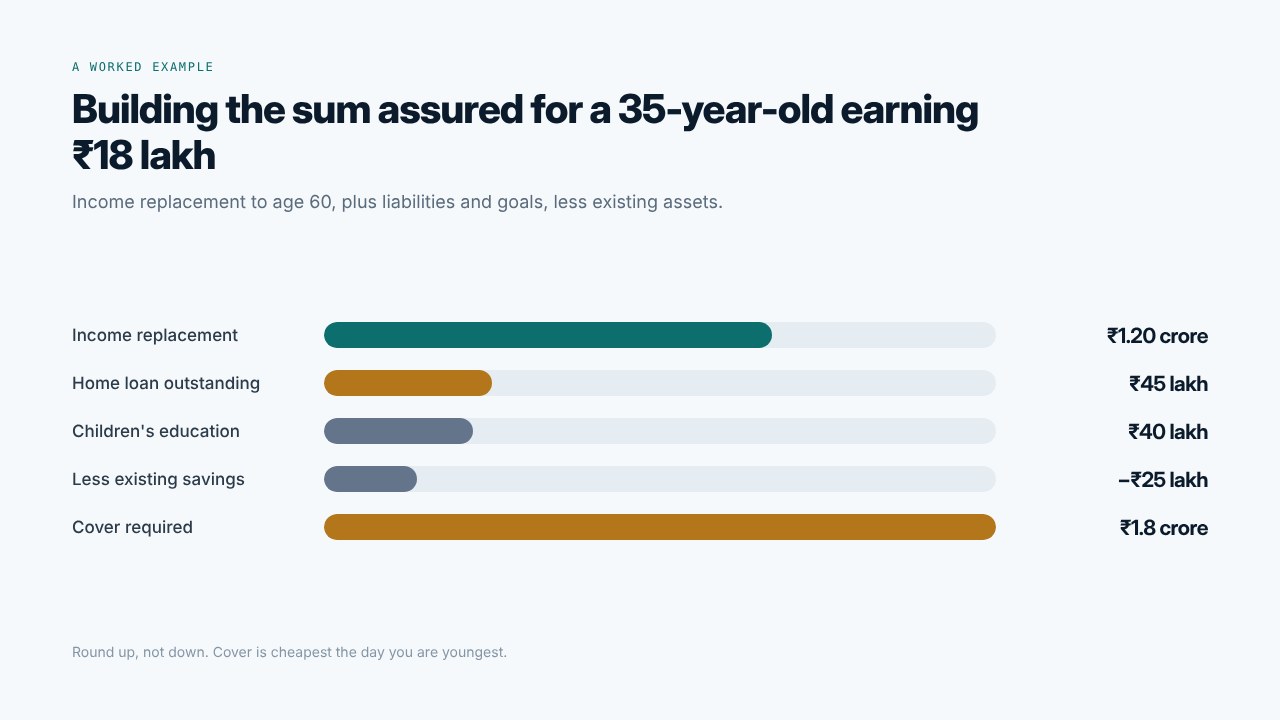
Income replacement. Take the share of your income your family actually depends on — not your gross, but what funds household spending — and multiply by the years until you would have retired. A 35-year-old whose family depends on ₹50,000 a month, with 25 years to 60, needs ₹1.5 crore in today's terms. Discount it a little for the return the corpus will earn; raising it for inflation and discounting for returns largely cancel out over long periods, so the simple figure is close enough.
Liabilities. Every outstanding loan, at today's balance. Home, car, personal, the business loan you guaranteed. These do not disappear; they land on whoever inherits.
Specific future goals. Children's education, mainly. A professional degree fifteen years out is ₹40 lakh to ₹60 lakh at current inflation. A wedding if you intend to fund one.
Subtract what already exists. EPF, PPF, mutual funds, deposits, and any employer group cover — though treat group cover as temporary, because it ends with the job.
Term, not endowment
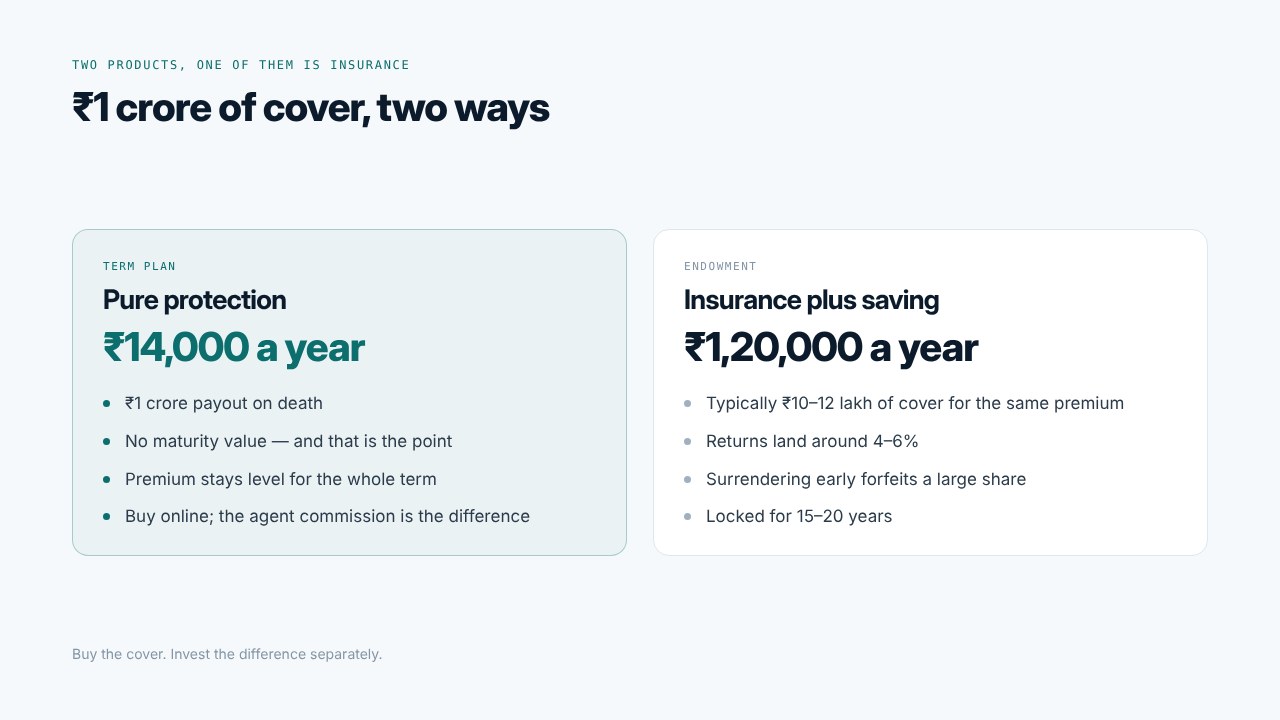
A term plan pays only on death. It has no maturity value, and that is exactly why it is cheap: ₹1 crore of cover for a healthy 30-year-old non-smoker costs ₹10,000 to ₹15,000 a year.
An endowment or money-back policy bundles a weak investment into the premium. The same ₹1 crore of cover is unaffordable in that structure, so what gets sold instead is ₹10 lakh of cover for ₹1.2 lakh a year, returning 4% to 6% over twenty years.
Your family does not need ₹10 lakh. They need the mortgage cleared and twenty years of expenses. Buy the cover, invest the difference, and keep the two jobs separate.
How long to cover
Until your dependants stop depending on you — usually until your planned retirement, or until the youngest child is financially independent, whichever is later.
Cover to 85 sounds thorough and mostly is not. By 65 the loan is gone, the children are earning and the corpus exists; there is nothing left to replace. Those extra decades raise the premium substantially for a payout nobody will need.
Three things that void a claim
Not disclosing a condition. Diabetes, hypertension, a past surgery, a family history of heart disease. Disclose everything. The insurer may load the premium or exclude something, which is survivable. A claim rejected for non-disclosure is not. After three years, section 45 of the Insurance Act bars repudiation on grounds of misstatement — but that protection only helps if the policy survives that long.
Not declaring that you smoke. Occasional counts. Smoker premiums are roughly double, which feels like a reason to stay quiet, and is the single most common cause of rejected claims.
Letting it lapse. Auto-debit the premium. A policy that lapsed three months before the claim pays nothing.
Riders, briefly
Most are not worth the premium. Two are worth considering: a critical illness rider, which pays a lump sum on diagnosis of a listed condition, and an accidental disability rider, which pays if you survive but cannot work.
Waiver of premium is cheap and sensible. Accidental death benefit is usually not — your family's needs are the same whatever the cause.
Buying it
Buy online, directly from the insurer. The premium is lower because there is no commission, and the medical test is arranged for you either way.
Compare on claim settlement ratio and on the insurer's solvency, not on price alone — though with term plans the price differences between reputable insurers are small. Name the nominee correctly, and remember that under section 39(7) of the Insurance Act a nomination in favour of a parent, spouse or child makes them a beneficial nominee, entitled to keep the proceeds. That is one of the few places where nomination and entitlement actually align.
Read next
 Estate Planning
A nominee is not an heir — why your will still matters
Filling in a nomination form feels like estate planning. It is not. A nominee receives the asset; who is entitled…