Home/ Income Tax/ Article
Form 16, read line by line
Form 16 arrives some time in June, gets saved to a folder, and is opened again only when someone asks for it. That is a shame, because it is the one document that tells you exactly what your employer told the Income Tax Department about you — and if the two of you disagree, the department believes the employer.
Part A is the receipt
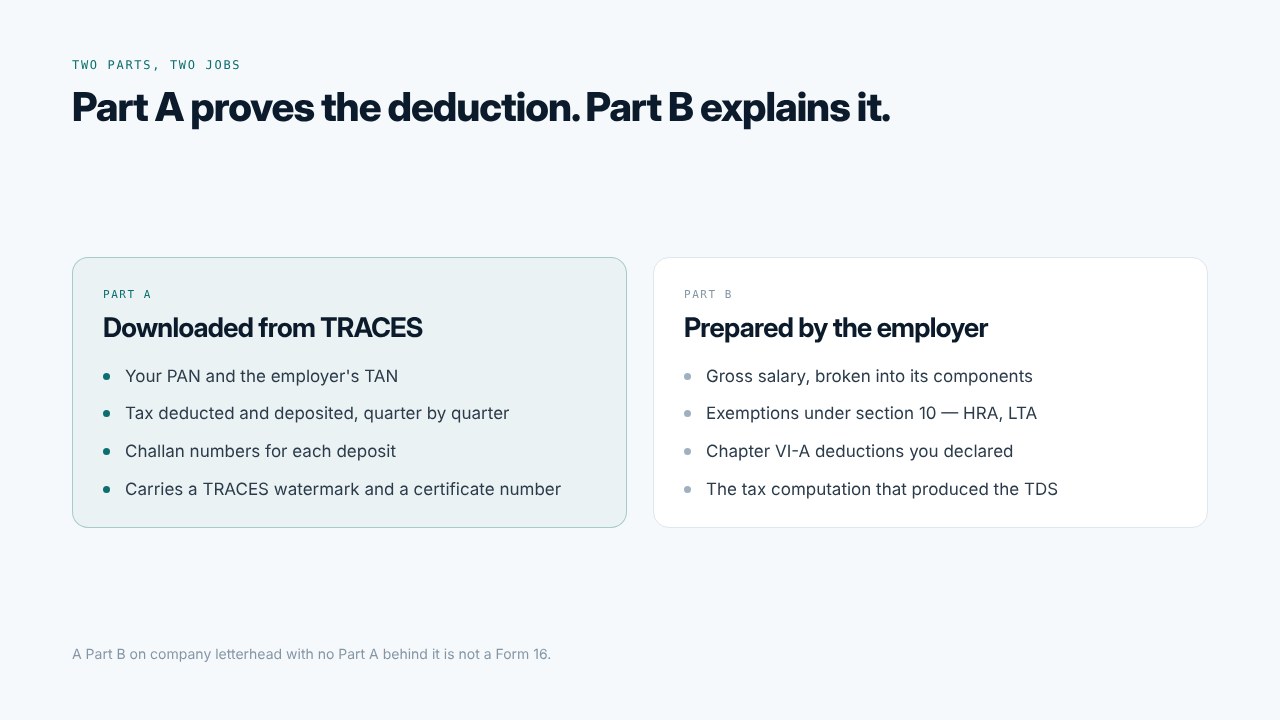
Part A is generated by TRACES, the department's reporting system, and downloaded by your employer. Your employer cannot type it. It carries a certificate number, a TRACES watermark, your PAN, the employer's TAN, and a quarterly table of tax deducted and tax deposited.
Those two columns are not the same thing, and the difference matters. Tax deducted is what came out of your salary. Tax deposited is what actually reached the government. When a company runs into cash trouble, the first column keeps moving and the second one stops. You will not notice from your payslip. You will notice when your refund does not arrive.
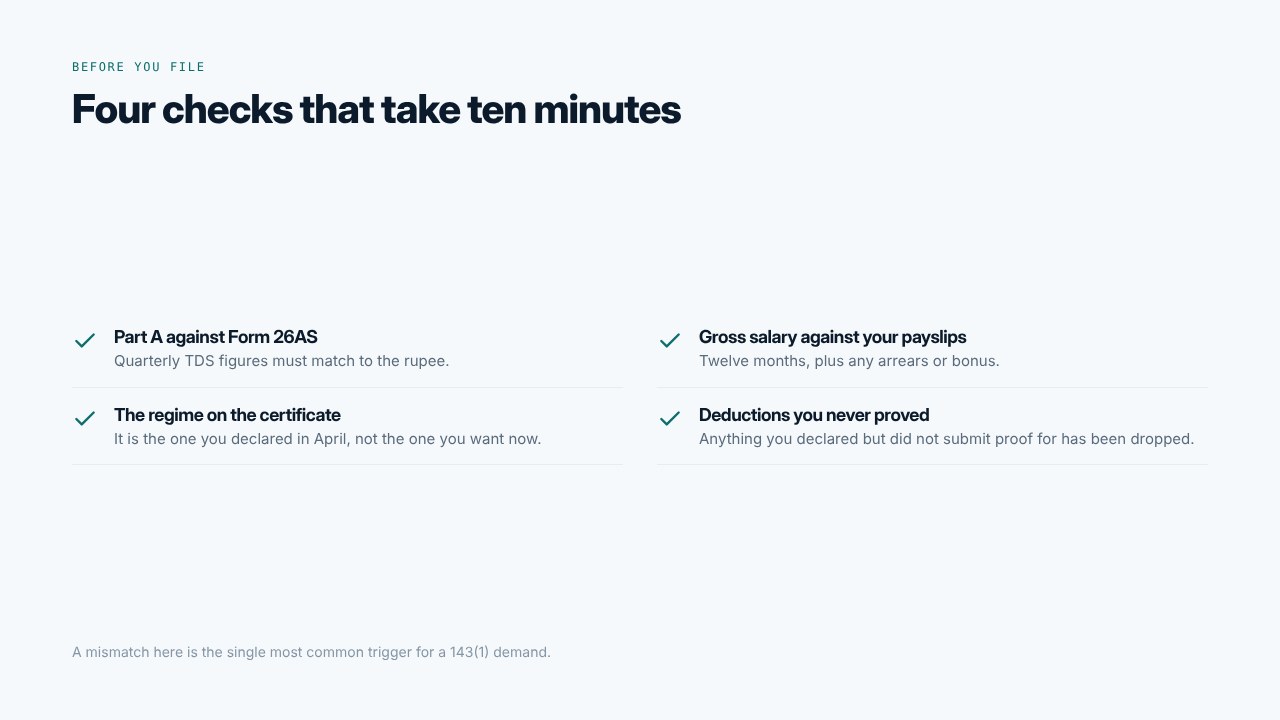
Check the quarterly figures in Part A against your Form 26AS on the e-filing portal. They should match exactly. If 26AS shows less, the money was deducted and not deposited, and that is a conversation to have with your employer in writing, not over a desk.
Part B is the explanation
Part B is prepared by the employer and shows the working: gross salary split into basic, allowances and perquisites; exemptions claimed under section 10; deductions under Chapter VI-A; and the tax that falls out of all of it.
This is where errors live, because this is the part a human filled in.
Gross salary
Add up twelve months of payslips, including any bonus, arrears or leave encashment paid during the year. The total should match. A joining bonus paid in April of the following year belongs to that year, not this one — a surprisingly common source of mismatch.
Section 10 exemptions
HRA, leave travel allowance, gratuity and leave encashment on retirement sit here. If you submitted rent receipts in January and the HRA exemption is zero, the declaration did not reach payroll. That is worth chasing now, because claiming it yourself at filing stage means explaining a gap between your return and your Form 16.
Chapter VI-A deductions
80C, 80D, 80CCD(1B), 80E and the rest. Only what you actually submitted proof for appears here. What you declared in April but never documented has been quietly dropped, and the TDS for February and March was recalculated upwards to recover it. That is usually the answer to why your take-home fell in the last quarter.
The regime box
Somewhere near the top of the computation, Form 16 states which regime was applied. It reflects what you declared to payroll in April, not what suits you now.
This catches people every year. You told HR "new regime" in April because the form needed an answer, then bought an insurance policy in December and now the old regime is cheaper. You can still file under the old regime — a salaried person with no business income chooses afresh at filing — but your return will then show a lower tax than your Form 16, and the refund takes longer because the figures have to be reconciled.
It is worth running both regimes in April rather than in December, so the declaration matches what you will actually file.
Two Form 16s in one year
If you changed jobs, you have two, and each was prepared as though it were your only income. Both applied the basic exemption. Both applied the standard deduction. Added together, they have under-deducted, often by a large amount.
The fix is to declare your previous salary to the new employer in Form 12B when you join. Most people do not, and discover the shortfall as a demand at filing, along with interest under sections 234B and 234C. If you switched jobs this year and did not file a 12B, assume you owe something and work out how much before 15 March rather than in July.
No Form 16 at all
An employer only has to issue Form 16 where tax was deducted. If your income was below the threshold and no TDS was cut, there is nothing to issue, and you file from your payslips and your Form 26AS instead.
Where tax was deducted and no certificate arrives, the employer is in default, and section 272A provides for a penalty of ₹100 a day. In practice a polite written reminder quoting that section produces the document.
What it does not cover
Form 16 only knows about salary. Interest from your bank, dividends, capital gains on shares sold during the year, rent — none of that is in it, and all of it is in your Annual Information Statement. Filing from Form 16 alone, when the AIS shows a mutual fund redemption your employer never knew about, is precisely how a routine return turns into a notice.
Read next
 Income Tax
Eight ITR filing mistakes that trigger a notice — and how to avoid each one
Almost every scrutiny notice we see starts the same way: the return says one thing and the Annual Information Statement…
 Income Tax
Old regime vs new regime: how to actually decide
The break-even depends on how much you genuinely claim, not on what you could claim.