Home/ Retirement Planning/ Article
NPS or mutual funds: where should retirement money actually sit?

Both are sensible places for long-horizon money, and the usual framing — which gives better returns — is the wrong question. They can hold the same underlying assets. What differs is the cost, the tax treatment, and what you are allowed to do with the money.
Cost
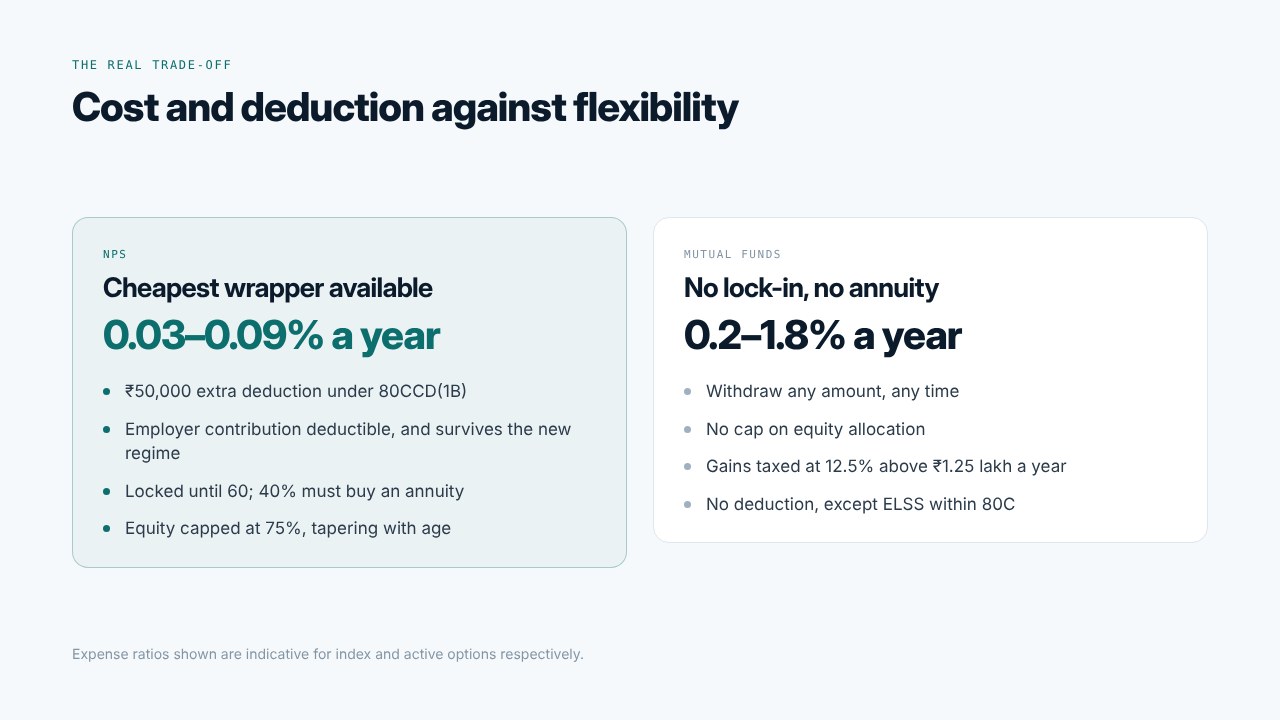
NPS is the cheapest investment wrapper available in India by a wide margin. Fund management charges run between 0.03% and 0.09% a year. An active equity mutual fund charges 1.2% to 1.8%; a direct index fund, 0.2% or less.
Over thirty years a one-point difference in annual cost is enormous. On ₹10,000 a month at 10% gross, the gap between 0.09% and 1.5% is well over ₹50 lakh at the end. That is the strongest argument for NPS and it is rarely the one people cite.
Tax
NPS carries a ₹50,000 deduction under 80CCD(1B), on top of the ₹1.5 lakh under 80C. More useful still, an employer contribution under 80CCD(2) — up to 10% of basic for private employees, 14% for government — is deductible and is one of the very few deductions that survives in the new tax regime.
If your employer offers NPS as part of the salary structure, that is close to free money and worth restructuring for.
Mutual funds carry no deduction, apart from ELSS inside the 80C limit. Gains on equity funds are taxed at 12.5% above ₹1.25 lakh a year when held beyond twelve months.
The annuity, which is the real cost of NPS
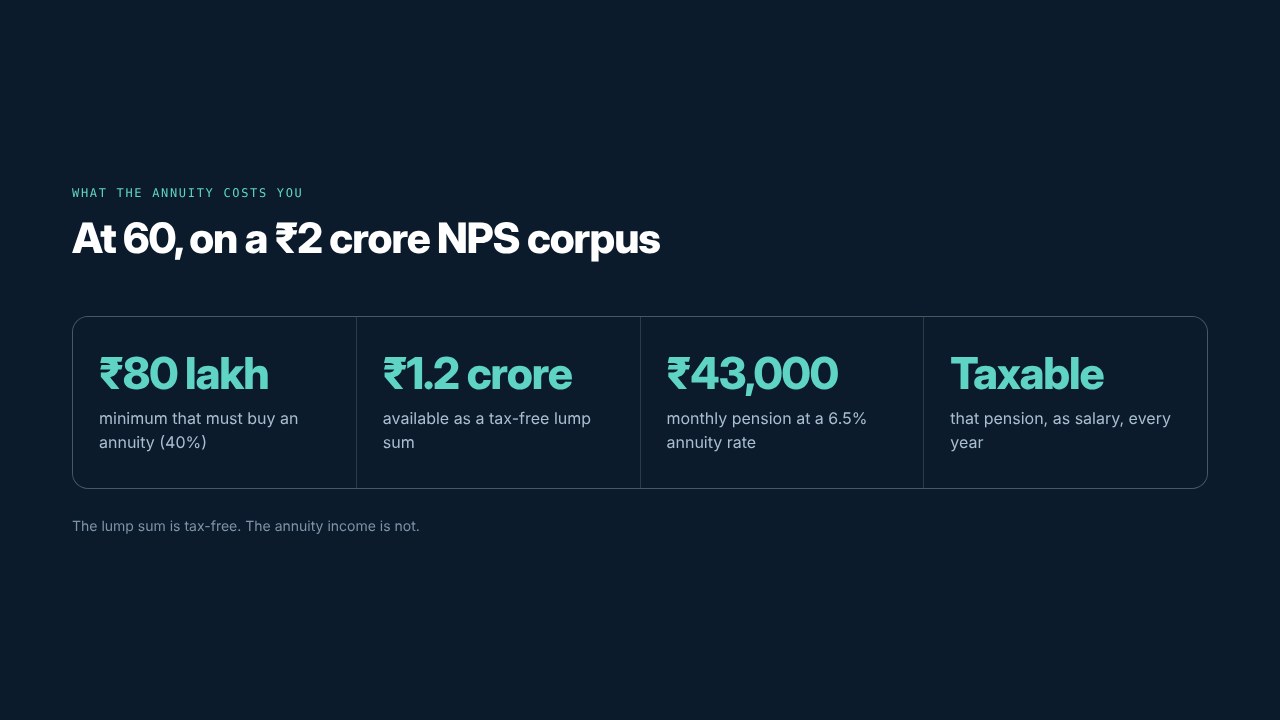
At 60, at least 40% of the corpus must buy an annuity. The remaining 60% comes out tax-free.
Annuity rates in India have run around 6% to 7%, below what a balanced portfolio earns, and the pension is taxable as salary every year you receive it. So the compulsory 40% moves from a low-cost growing asset into a lower-yielding taxable one, permanently, with no option to change your mind.
On a ₹2 crore corpus that is ₹80 lakh converted into about ₹43,000 a month of taxable income. Whether that is good or bad depends entirely on whether you want guaranteed income or control. Project your own corpus and the pension it buys before assuming either.
Liquidity
Mutual funds can be redeemed any day for any reason. NPS cannot. Partial withdrawal is permitted after three years, capped at 25% of your own contributions, and only for specified purposes — education, marriage, a first home, serious illness.
Exiting before 60 entirely is possible but punitive: 80% of the corpus must go into an annuity, leaving 20% in hand.
For a 30-year-old, NPS is a thirty-year commitment. That is a feature if you are prone to raiding long-term savings, and a problem if your income is uncertain or a business might need capital.
Control over allocation
NPS caps equity at 75% and tapers it down with age under the auto choice. Even under the active choice you cannot exceed the cap.
For a 30-year-old with thirty years to run, 75% equity is defensible but conservative; many would hold more. Mutual funds let you choose freely — including the freedom to be badly wrong, which is the honest counter-argument.
A reasonable order
For most salaried people:
- Take the employer NPS contribution under 80CCD(2) if it is offered. It is deductible under both regimes and costs you nothing.
- Add the ₹50,000 under 80CCD(1B) if you are on the old regime and comfortable with money locked until 60.
- Everything beyond that into mutual funds, for the liquidity and the absence of an annuity requirement.
That gives you the cost advantage and the deduction where they apply, without committing your entire retirement to a product you cannot adjust for three decades.
And whichever wrapper holds it, the amount matters more than the vehicle. Work out the corpus you need first — the gap between what people are saving and what they will need is almost always larger than the gap between any two products.
Read next
 Retirement Planning
How big a retirement corpus do you actually need?
Inflation, not returns, is what decides the number.